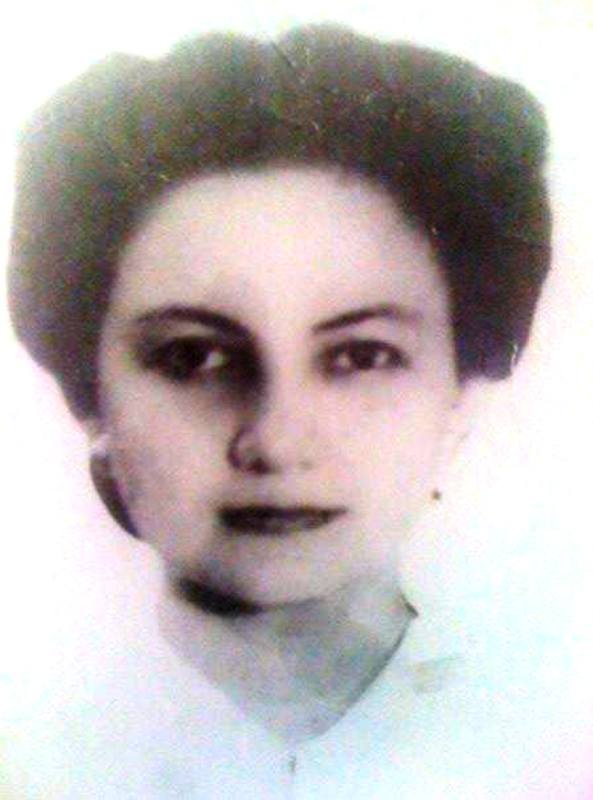
She was a beauty and remained so until her last days about two weeks ago when she passed away a few days after she celebrated her 99th Birthday ….…
Tante Dee’s father was Joost Willem Tambajong and her mother was Johanna Maria Wilson Mononutu. Opa Joost and my grandfather Opa Jan Nicolaas Tambajong were brothers. Each of them had a very different lifeline. My grandfather being the eldest son had his destiny in the “Public service” which means he was in service of “ het Gouvernement van Nederlandsch-Indie” as “Majoor van Tombassian” stationed at Amurang.
Tante Dee’s father took a job at a German trading company in Manado and succeeded in creating a status that made his family lived well. Eventually he also bought a truck and my mother told me once that Oma Marie (Tante Dee’s mother) was therefore skilled in driving a truck….. and that in the early 19th century in Manado.
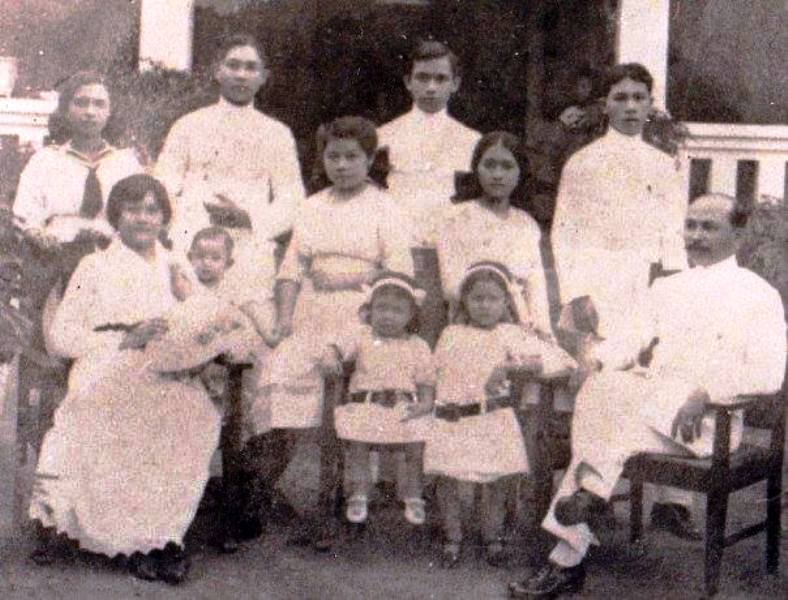
The family in Manado with Tante Dee sitting on the lap of her mother and my mother sitting in the second row right.
Later when the family moved to Batavia they stayed in a respectable area: Oude Tamarindelaan (Now Jalan Wahid Hasyim) on a property bought by Tante Dee’s father. Because he was diligent and able at the end of each calendar year he obtained a bonus. These funds he invested in new property in his neighborhood ….. Eventually these properties were located at a place where now the Jalan Thamrin (one of the most important roads in Jakarta) is.
In the garden of their house in Batavia
On the picture above my mother is at the rear. She apparently often frequented her aunts premises. At that time my mother was studying for her “hoofdacte” as a teacher and had her boarding at the “Vrouwenbond” (an intern for working women) located not very far from her aunts house.
Once when I was chatting with Tante Dee I told her that my father (at that time married to his first wife) when he was working as a teacher in Jogya had a “rijtuig” (a carriage pulled by a horse), she promptly added : “O ja…. Dat hadden wij ook!. (Oh yes we had one too…..) For me as a person of the 20th century, I could hardly imagine the implications of having such a carriage plus the horses plus the “driver” plus his family around the house. I understand now why at that time in Batavia the houses of the well to do had huge gardens …….
Tante Dee married a Medical Doctor Emiel Engelen, see the picture below.
Note: Thank you Jeanine for sending us this beautiful picture of your Mom’s wedding.
On the steps of the Willemskerk at Batavia.
Her husband had a well attended medical practice. They had six children four girls and two boys.
Unfortunately Oom Emiel died young for current standards…. He was 58 years old when he passed away. Therefore Tante Dee raised her children alone, with assistance of Oma Marie, her strong mother…… I think that financially she might have had no problems, at least not visibly.
Whilst she was living in Jakarta, four of her children emigrated to the US and live there well also. Tante Dee traveled to and fro from Indonesia to the US, like we might travel to and fro Jakarta – Bandung. It seems that she liked living in Indonesia because she had a group of friends all about 70 – 80 years of age meeting regularly to have a chat with each other.
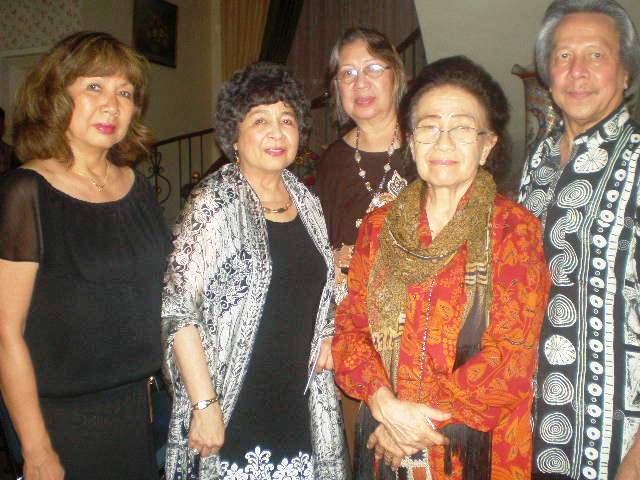
On a TAMBAJONG family gathering in 1988 at Jakarta, Tante Dee second from left
I have a lot of old pictures scattered around and I will add the gradually add them to this post when they eventually surface.
Two years ago I had the opportunity to be invited for the celebration of Tante Dee’s 97th birthday party. The occasion took place in a Restaurant named “Loempia” in central jakarta. I assume that it must be a Restaurant often frequented by her and her family in those “good old days” even before the war. I was lucky to be able to make a video.
Until a few years ago Tante Dee lived in a beautiful “Indiesch huis” at Sawangan in the southern part of Jakarta. One day my son Rano and I visited her there. To see the pictures that we made please click
A few days after her 99th birthday she passed away peacefully in Jakarta.
The latest and last pictues of Tante Dee :
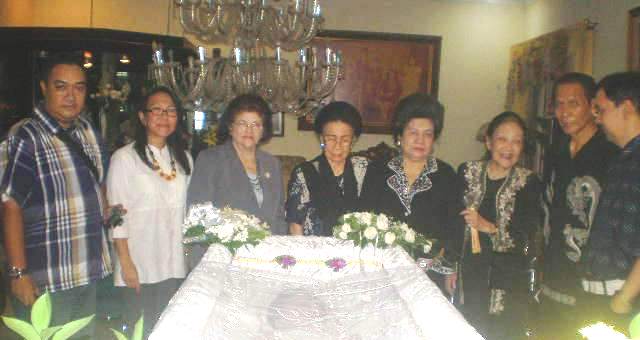
The evening before she was laid to rest. f.l.t.r Riri Sudjoko, Els Tampi-Engelen, Uki Sudjoko-R, Roos Wawolumaya-EngelenFrom l.t.r. Roy Tambajong , Riri,etc, Lani, Jappy Wawolumaya
On the so called “BLACK SUNDAY” or in Bahasa Manado “KUMAWUS”
June 15 th 2014, Baasje Engelen,Ille Engelen., Sally Tambajong, Uki R. Arthur Engelen, Baasje. Mayke and Arthur came over for the funeral.Roos W. Uki S., Lani, Baasje, Ille, Sally T.
Sudah satu setengah bulan berlalu setelah hari naas 15 Januari 2014…..
Beberapa hari setelah terjadinya musibah adik saya datang berkunjung dan menceriterakan bahwa saudara2 saya yang mempunyai kintal (property) di Sawangan, Kembes (pinggiran kota Manado) “kena” musibah banjir…..Dan kerugian aneka materi cukup besar. Maklumlah mereka kebanyakan adalah pensiunan seperti saya juga. Dan dirumah2 mereka disimpan berbagai perabot antara lain yang sangat berharga seperti piano kelas top, pantaslah sebab saudara saya adalah lulusan sekolah musik di Roma. Disamping itu yang hancur juga adalah peternakan ayam dengan kapasitas beribu2 ekor ayam serta berbagao barang milik pribadi lainnya .
Dikatakan pula oleh adik saya bahwa menurut keterangan yang diperoleh maka penyebabnya adalah luapan air danau Tondano, dimana pintu ajr bendungan yang (katanya) ada, dibuka dengan sekali gus (a la “Tondano”) dan bukan secara bertahap (a la “lain tempat”) . Benar tidaknya penjelasan ini kita tunggu saja tanggapan KALAU ada. (Dan ternyata ADA, untuk itu silahkan lihat pada akhir posting ini “Thoughts on this post”.)
Kabar yang dibawa oleh adik saya mengingatkan saya kembali akan peristiwa yang saya alami 10 tahun lalu, yakni ditahun 2004 saya menghadiri suatu Konperensi Danau se Indonesia, karena kebetulan terbaca satu berita di koran bahwa ada satu organisasi internasional bernama LakeNet membantu penyelenggaraannya di Jakarta. Untunglah saya menemukan laporan kehadiran saya pada konperensi itu. Bahkan teringat pula hal2 kecil mengenai acara yang ditempuh. Pada waktu Pembukaan Konperensi saya lihat bahwa para peserta berasal dari berbagai daerah dan juga dari berbagai instansi yang terkait disamping pula pihak2 yang mungkin pernah atau sedang menjalankan kerjasama. Baik dari luar negeri dan dalam negeri. Selain dari pada itu ada beberapa wakil dari negara tetangga yang juga menyajikan pengalaman mereka dalam upaya pelestarian danau mereka seperti dari Pilipina.
Saya tentunya sangat tertarik kepada apa yang akan dilaporkan oleh Pengelola Danau Tondano. Waktu istirahat saya tanya kepada Ibu Dra. Hartiningsih, Ketua Panitia apakah Pengelola Danau Tondano sudah hadir. “Oh sudah…., ini laporan yang dibawanya mengenai Danau Tondano.” Saya diberikan satu berkas terdiri dari 3 halaman A4 ditik dobel spasi. (Di website saya diatas saya lampirkan pula naskahnya, maaf kurang jelas scanningnya). Waktu pembahasan laporan2 dalam sesi2 ternyata Laporan Danau Tondano tidak akan dibahas …..Mungkin karena isinya begitu “sumir” (alias tidak berisi materi yang berarti dan layak untuk didiskusikan permasalahan2nya). Pada sidang2 lanjutan wakil Sulut terkait sudah tidak kelihatan hadir lagi, padahal saya ingin sebenarnya berbincang2 dengannya. Yah…. pasti ada kegiatan lain yang perlu dia laksanakan, misalnya syoping di ITC yang katanya murah sekali macam2 barangnya……… Setelah saya baca dokumen yang diberikan ternyata judulnya
Laporan yang dibagikan tersebut tidak ada tanggal dan tandatangan mungkin karena seingat saya Bpk Sualang waktu itu sudah berada di Rutan Salemba, Jakarta. Sebagai satu laporan yang seyogyanya mengharapkan tindak lanjut atau sedikitnya ada kekuatan bobotnya karena didukung oleh satu forum semi-internasional jelas tidak mememenuhi syarat. (Waktu pada saat break saya sempat ngobrol lagi dengan Ibu Hartiningsih dan saya mengeluh karena “disintererst” (tidak adanya perhatian) pihak pelapor SULUT pada materi bahasan, maka Ibu Hartiningsih menjawab: ” Memang begitu, Bu….. karena tidak “basah”…….selalu begitu.” AMPUNNN, kalau “danau” tidak “basah” memang sudah gawat keadaannya……..)
Sebenarnya sedari tahun2 2004ankeatas maka sekali2 waktu saya browsing dengan Google perihal Danau Tondano. Agaknya jikalau kita bikin printout dari naskah2 tersebut maka kita sudah mendapat tumpukan setinggi 45 cm sepertinya. Seyogyanya para penanggung jawab perlu membaca dan MEMPELAJARI laporan2 tersebut untuk mencari SOLUSI bagi masalah Danau Tondano agar dapat tersusun satu ROAD MAP kearah implementasi solusi itu .
Namun demikian……. para pengelola mutlak perlu melaksanakan itu.
INGA! …… INGA!….. betapa besar nilai kehilangan nyawa dari warga2 Manado dan sekitarnya dan INGA! betapa besar kesedihan saudara, suami, istri, anak , kakak, adik yang kehilangan anggauta keluarganya pada musibah ini dan musibah2 sejenis yang secara periodis berlangsung…..
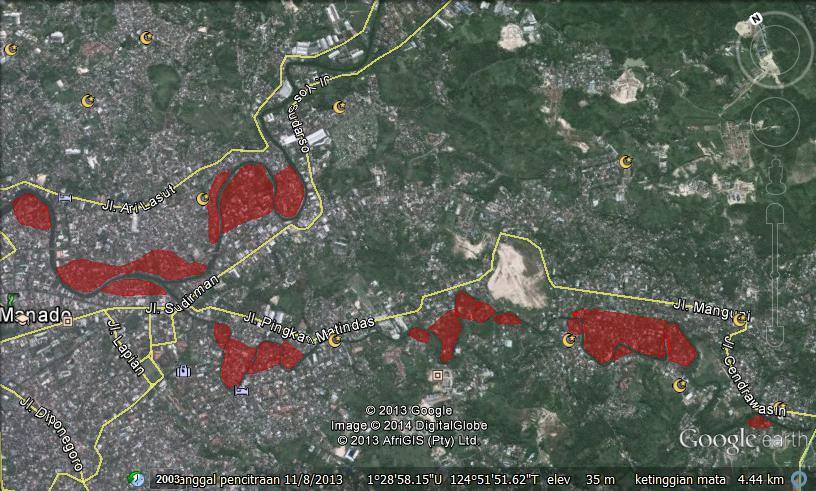
Pocket2 daerah dimana warga terperangkap banjir Manado 2014 (Team SAR Steven Sumolang)
Dapat terlihat dari gambar diatas dan dibawah ini bahwa banjir bandang Manado 2014 memang disebabkan TERUTAMA oleh tumpahan Sungai Tondano disamping faktor2 lain.
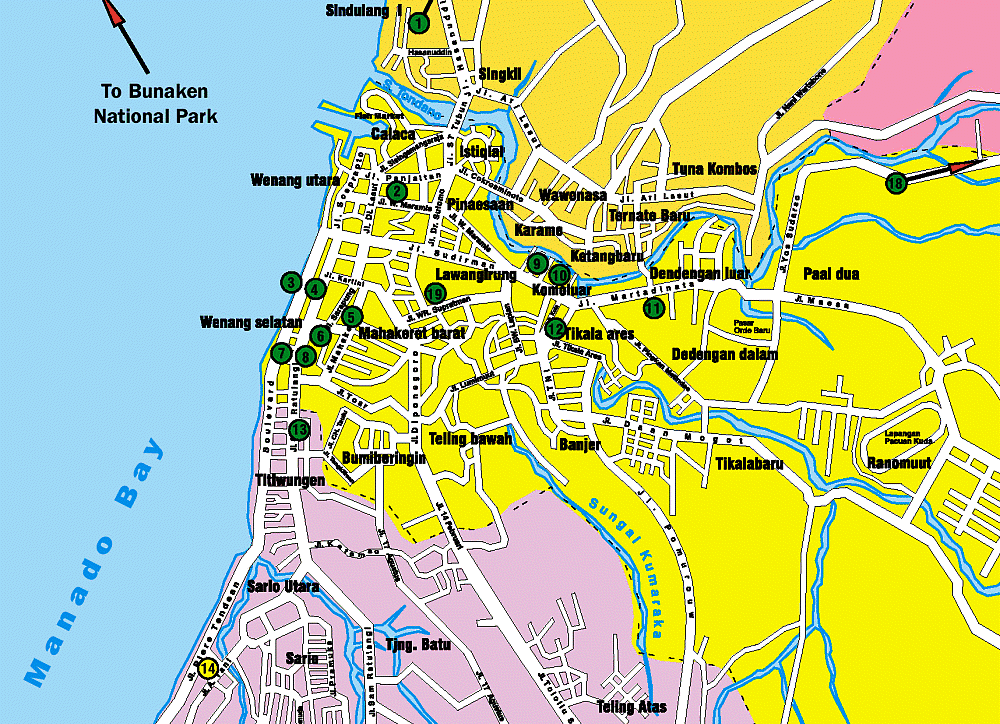
Map-of-Tondano-Lake-Watershed (Gambar dari studi Elsje Pauline Manginsela)Peta Jalan Manado (untuk orientasi bagi yang kenal Manado)
Untuk membaca SALAH SATU dari sekian Laporan Ilmiah tentang gawatnya keadaan Danau Tondano, silahkan klik pada tautan berikut:
First published in The Sunday Post 8 September 2013
SEBAGIANnya saya kopy dibawah ini
“In 1934 Dutch engineers measured the lake’s depth at an average 40 meters. Forty years later it was 28 meters and two years ago just 12, according to the North Sulawesi Environmental Management Agency.Between 2003 and 2005 the lake and its surrounds were mapped and researched. About a third of the watershed was identified at risk.
Areas of land were replanted with around 10,000 trees. Erosion banks were installed in 21 demonstration plots that included crop rotation to reduce runoff. The long term aim was to help lift incomes and living standards for the people who rely on the lake for food and irrigation. The Minahasa Region, centered on Tondano town, has a population of more than 300,000.
Suitably impressed the Czech Republic began funding a five-year US $415,000 (Rp 4.3 billion) rehabilitation project through its development agency in association with the Minahasa Regency. That was in late 2008 – and it couldn’t have started at a worse time. The global economic crisis hit Europe and within two years the funds had vanished. But not
the weed. Locals had dragged some of the huge green carpets ashore to dry but the task is Herculean. Enthusiasm wilted when the cash flow stopped.
Small sheds were erected on the lakeside housing engine-powered shredders so the dried nitrogen-rich material could be processed into fertiliser. The machines stand idle, quietly rusting while the wind-whipped weed laughs its way to the
further bank, dropping seeds that can last up to 30 years. Rabbits are supposed to be prolific, but eceng gondok can double its population in just over a month.
Despite its criminal record, that includes harboring mosquitoes and starving the lake’s nike fish of oxygen, the weed has some redeeming qualities. It sucks up heavy metals including arsenic so can purify polluted water, particularly from industrial sites. The dried stems are strong, particularly when braided into ropes. Woven through wood or bamboo
slats it makes robust chairs and sofas, though manufacturers say the gray material is too waxy to take paint or varnish. It can also be used to make paper. “The main aim was to bring new cropping patterns that would benefit farmers and also introduce crops for production of biofuels,” said the former project manager Dr Karel Peter Kucera. “There’s a shortage of fuels for transportation and cooking, so farmers have started to cut the trees again. Bio fuels could be used to address this situation.
“We identified about 15,000 hectares that could be used to establish agroforestry plantations. We also recommended harvesting the eceng gondok and use it for production of organic fertiliser, bio gas and furniture.”
In 2011 the Environment Ministry launched a Lake Rescue Plan (GERMADAN) to save 15 lakes, including Tondano. It is understood most attention is being given to Lake Kerinci in Central Sumatra and Lake Rawapening in Central Java.This year nine ministries signed an agreement for ‘sustainable management’ of the lakes. No budget was announced. An Environment Ministry officer said regional governments had to do more to protect their lakes. In Tondano’s case allowing the spread of fish farms was aggravating the problem becaus feed and excrement encouraged weed growth.
In April this year North Sulawesi, Governor Sinyo Sarudajang told Antara News that he was committed to handling the problem. German experts would visit the lake “soon” and see if the weed could be used to make bio-gas.
However his staff said it was not known when the German team would arrive. A circuit of the lake found no sign of control measures, and villagers claimed nothing was being done to halt the invader.
Indonesia isn’t the only victim of eceng gondok, but it seems to be one of the most passive. Elsewhere a war is being waged with machines, chemical sprays and insects, though all have their downsides. An infestation in Florida is now reported to be under control.
“The lake should be saved,” said Dr Kucera, “but it needs a good feasibility study and I think honest international and local investors.”
First published in The Sunday Post 8 September 2013
JADI………. Sambil menunggu KAPAN Bapak Sarundayang ada waktu mengundang dan membahas hal2 bekenaan dengan penyelamatan Danau Tondano……. Marilah kita membaca dulu komentar2 dan rekomendasi2 disalah satu laporan riset yang ada ditumpukan virtual Laporan2 mengenai Danau Tondano:
SILAHKAN BACA Bapak2/Ibu2 Legislatip/Eksekutip Kabupaten MINAHASA:
(Terejemahan dibuat oleh Lani Ratulangi)
A weakness at the district level is a low level of technical capacity to analyze and evaluate natural resource issues. There is a need to utilize technical assistance to monitor and evaluate environmental quality. The district governments need to develop better linkages to the local University, other research institutions, non-government organizations and other groups
offering technical assistance to better utilize the expertise of these organizations.
Kelemahan ditingkat kabupaten adalah rendahnya kemampuan teknis untuk menganalisa dan mengevaluasi isu2 sumber daya alam. Ada kebutuhan untuk menggunakan bantuan teknis untuk memonitor dan mengevaluasi kwalitas lingkungan. Pemerintah kabupaten perlu mengembangkan kaitan2 yang lebih baik dengan universitas2 setempat, lembaga2 penelitian lain, organisasi2 non-pemerintah (LSM2) dan lain2 kelompok yang dapat memberikan bantuan teknis agar keahlian2 yang ada pada orgenisasi2 ini dapat digunakan lebih baik.
The comparative advantage of local government at the district level is it closeness to the people, but local governments have not yet developed effective systems for community consultations on environmental issues. This is partly due to the bureaucratic culture evolved from the New Order years as well as a lack of training in approaches to foster greater community participation.
Keutungan komparatip pemerintah kabupaten adalah dekatnya kepada penduduk, namun pemerintah lokal ini belum membina sistem2 konsultasi masyarakat yang efektip mengenai isu2 lingkungan. Ini sebagiannya adalah akibat dari budaya birokrasi yang berlangsung dimasa Orde Baru, namun juga akibat kurangnya latihan dalam pendekatan untuk membina partisipasi masyarakat yang lebih besar.
Greater attention should be given to development of this capacity in order to better achieve the objectives of local government.
Perhatian yang lebih besar perlu diberikan kepada pembinaan kemampuan yang disebut diatas agar tujuan2 pemerintah lokal dapat dicapai dengan lebih baik.
There is also a critical lack of accurate information at the district level on the natural resources of the district. Mapping and information on natural resources tends to be compartmentalized by sectoral agency and not available to the public. There is a need to develop a more comprehensive data base which is easily accessible to all government agencies and to the public.
Juga diamati ada keterbatasan yang kritis pada tingkat kabupaten mengenai informasi2 akurat tentang sumber daya alam yang ada dikabupaten. Pemetaan dan informasi tentang sumber daya alam ternyata terkompertemen secara sektoral pada dinas2 terkait dan tidak untuk umum. Sangat diperlukan adalah pengembangan satu data base yang komprehensip yang mudah diakses oleh semua dinas pemerintah dan umum.
Post Scriptum
Hari2 ini (akhir Februari 2014) di beberapa media misalnya :
disebut perihalpembangunan waduk atau bendungan “untuk mengurangi resiko tumpahan banjir dari DanauTondano seperti terjadi tanggal 15/1/2014”. Puji Syukur kepada Tuhan ……..
NAMUN itu baru mengatasi sebagian dari masalah Danau Tondano. AKAR permasalahan belum tersentuh. Dan akar2nya terletak pada deforestasi yang terjadi di HULU DAS Tondano (memerlukan replanting), padasedimentasi didasar danau (harus dikeruk) sertaeutrifikasi dibadan air (harus membersihan air), enceng gondok dipermukaan air (harus dicari upaya pendaya-gunaan) dll hal yang disebut dilaporan2 yang sudah lama itu. Ada berbagai rekomendasi2 yang sama sekali tidak diperhatikan bahkan dibikin proyek penelitian baru lagi dan baru lagi dan baru lagi…..Yang diperlukan adalah perhatian SUNGGUH2 dan KONSISTEN akan upaya pelestarian ini. Diketahui bahwa disamping memakan waktu minimal lima tahun dengan kebutuhan dana yang SUPER besar yang harus diajukan permohonannya kepada pusat (“Blue Book” BAPPENAS). Hal ini memerlukan kemauan, semangat, kejujuran dan “ausdauer” yang besar. Oleh karena itu YTH Bapak Gubernur SULAWESI UTARA perlu sesegera mungkin menetapkan satu Team Pengelola Danau Tondano yang bertanggung jawab penuh, yang profesional dan FULL TIME. Sebaiknya berasal dari dinas2 sektoral dan lembaga2 penelitian. Hal ini diperlukan karena Sang Danau Tondano sudah memberikan peringatan keras agar masyarakat SULUT segera memilih: PELESTARIAN DANAU TONDANO atau “more of the same as on 15 January 2014” . Silahkan pilih….
Sudah lama saya tidak menulis apa2 di blog saya….. bukan karena tidak ada bahan yang ingin saya “lepaskan” bukan…, namun kebetulan ada halangan karena satu kegiatan lain ……..
Sekali ini sudah tidak dapat kutahan luapan perasaan melihat derita yang sejak tanggal 15 Januari ini ditanggung banyak sekali penduduk Minahasa, khususnya penduduk daerah sekitar kota Manado….. kota yang (katanya) indah bagaikan mutiara dipinggir Samudera Pasifik.
Melalui berbagai media cetak maupun elektronik, kita yang masih ada sekedar ikatan… ikatan apa ya? dengan Minahasa menyaksikan gambar2 yang memilukan melihat daerah2 yang semakin lama semakin tergenang oleh curahan air yang berasal dari hujan yang tak henti2nya.
Kebetulan pada tanggal 15 Januari ybl pagi saya baca berita di FB dari temanku Veronica Kumurur bahwa anak2 sekolah di manado diliburkan sehari berkaitan dengan ada kemungkinan cuaca sangat buruk yang berasal dari topan (?) di Philipina akan menimpa kota Manado…. Pikiranku hebat juga Dinas Pendidikan yang cepat menyampaikan berita “Early Warning” menjadi “action” ke eselon2 bawah….
Pada malam hari itu putera saya berkata “Manado parah” lalu menceriterakan apa yang dilihat olehnya di TV. Keesokan harinya pagi2 saya buka netbook saya dan pada halaman2 FB melihat foto2 dab juga video yang dibuat saksi mata yang berkat BB, iPad atau iPod dll dapat dikirim. Alangkah menyedihkan,,,,, Dan saya melihat kembali tahun 2007 Januari, desa Ranowangko “anyor” kata orang disana maksudya “hanyut”….. mereka visualisasi kepada saya bagaimana mereka melihat kulkas dll. perabot rumah tangga mereka terapung2 meninggalkan mereka…. Untung beberapa oma2 yang tidak terlalu cepat tanggap bisa dibantu oleh bebrapa orang muda sehingga selamat. Saya ingat juga bagaiman temanku Joseph Karamoy (waktu itu masih aktip bekerja di rig di Laut Cina) pada saat cuti mengumpulkan dana dan sumbangan2 lainnya dari masyarakat Jakarta yang dibawanya sendiri ke “TKP” Tempat kejadian peristiwa banjir itu. Waktu semua barang2 diserahkan pun ada foto2nya….
Saya teringat juga bahwa pas tanggal 26 Januari 2013 saya ke Jakarta bersama suami setelah mengalami badai beberapa hari sehingga jetty kami porak poranda. Namun keesokan harinya yakni tanggal 27 Januari 2013 dilaporkan banjir dan longsao di daerah Tombariri dekat pantai sehingga memutuskan hubungan Tumpaan ke Tomohon sehingga seorang saudara saya yang sudah beli tiket untuk ke Jakarta terpaksa naik ojek mengambil jalur Popontolen, Poopoh yang walaupun jalanannya agak terendam masih dapat dilalui….
Timbul dipikiranku….. apakah musibah2 sejenis yang secara periodik menimpa daerah”ku” yang dinamakan Minahasa (SULUT) tidak dapat diantisipasi atau dihadapi lebih rasional?. Apalagi mengingat adanya pemanasan global dan pengaruh2 lain “kata orang”, mungkin akan dapat memberikan musibah yang lebih dahsyat lagi.
Musibah2 seperti ini tidak boleh dianggap sepele atau setengah hati dan nanti, setelah badai berlalu….. menjalankan “business as usual”. Kita selaku orang yang beragama dan berakal harus berdoa dan bekerja memikirkan bagaimana menghadapi masa depan agar bisa siap tanggap menghadapi apa yang mungkin akan terjadi.Di Sulawesi Utara cukup banyak ahli2 diberbagai bidang yang jikalau diberi kesempatan berkarya, atau di DENGARkan saja bisa menyumbang buah fikiran dan hasil kerja mereka. Saya lihat bahwa mereka sepertinya TIDAK DIHARGAI bahkan mungkin terkadang dianggap sepele dan disuruh ber-litbang saja (yang sebagaimana Anda dan saya ketahui artinya “sulit berkembang”.
Saya juga amati sesuatu yang lucu sewaktu masih agak lama di SULUT ini….. yakni gejala bahwa “Government can do NO WRONG” dpl Pemerintah atau Aparatur IS ALWAYS RIGHT yang mengimplikasikan juga THEY will do it THEMSELVES and according to THEIR WAY….. dan itu tentunya adalah sangat bagus kalau “THEIR WAY” is the appropriate way and most of all ARE THEY ABLEto do it their way ?? Juga kuamati pejabat Pemrintah Daerah berkelakuan bagaikan “little gods and godesses” apalagi bagi eselon2 atas……..
Diantara beberapa dari ahli2 yang perlu didengarkan adalah temanku Veronica Kumurur ……
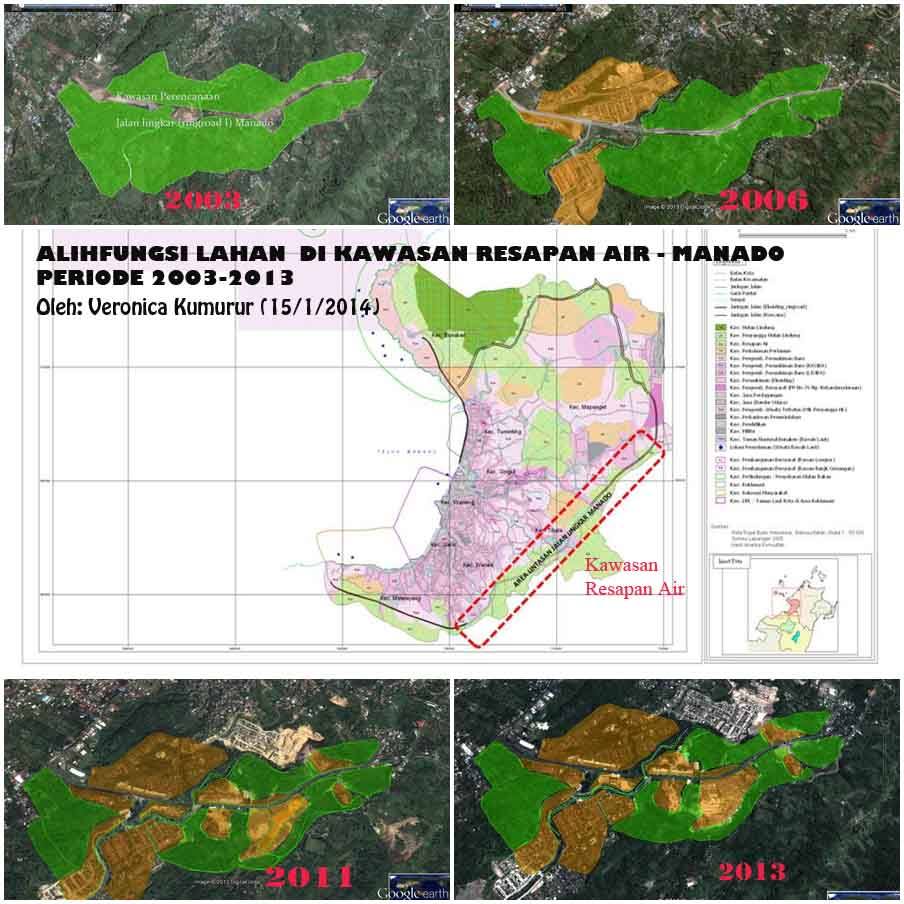
Dibawah ini beberapa gambar hasil studi oleh DR Ir. Veronica Kumurur (Dosen UNSRAT) yang dibuat berdasarkan data/material yang ada padanya (Gambar dapat di klik lalu diperbesar) :
Gambar 1.Memperlihatkan area yang seharusnya melindungi daerah kota Manado terhadap arus air hujan berlebih.Gambar 2. Penjelasan teradap kejadian banjir di daerah Citraland, Manado Selatan. memperlihatkan daerah yang seharusnya berfungsi bantaran.
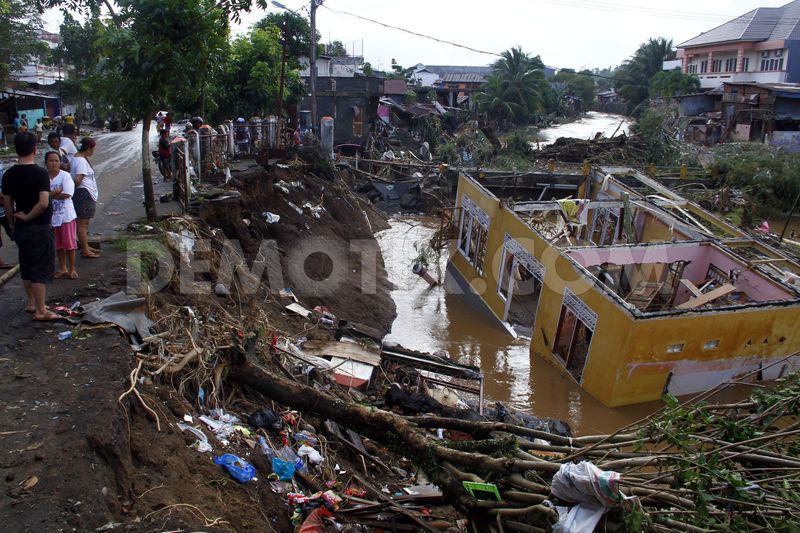
PENDERITAAN MASYARAKAT yang MENJADI KORBAN BANJIR MANADO
(Semua gambar dari internet)
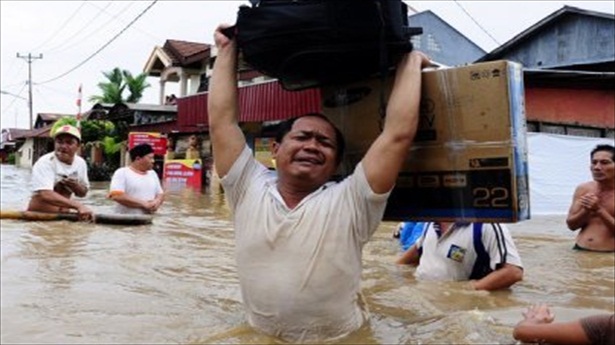
Gambar 3. Anjing diatas kantor Lingkungan Hidup yang kelihatannya sangat sederhana (Ironis juga)Gambar 4. Seorang warga berupaya menyelamatkan barang keperluannya yang masih sempat terjangkauGambar 5. Seorang ibu lansia dibantu menyelamatkan diri.Gambar 6, Mengamati dengan kesedihan.Gambar 7. Entah apa yang ada dibenak bocah ini…….Gambar 6 . Apa saja yang tergapat untuk diselamatkan
Gambar 9, Memindahkan korban2 ke penampungan…….
Gambar 10. Menurut Vero: Hanya 1 tahun saja area terdampak banjir menjadi sangat luas. Jika pemerintah dan seluruh msy Kota Manado dan sekitarnya (Tomohon, Minahasa, Minahasa Utara) tidak memerhatikan dan tidak segera bertindak, maka daratan Kota Manado (daratan Minahasa) akan tenggelam.
SEMOGA BADAI 2014 SEGERA BERLALU dan kita bisa menarik pelajaran dari berbagai kejadian2, lalu mempersiapkan suatu pola untuk masa depan yang lebih cerah
A few days ago I received a document from my eldest sister, who currently is 91 years old and living in the Netherlands. This document with her permission I publish below here. However it might be useful to have some references about the subject matter to try to give you a few introductory impressions.
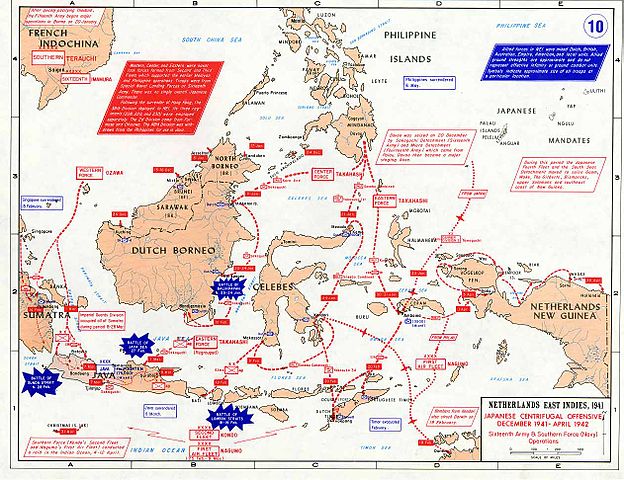
On 8 December 1941 the Netherlands declared war to Japan, upon which General Terauchi began to attack to Borneo; on 17 december the Japanese troops landed at Miri, an oil production center northern Sarawak.
Japanese attack on Nederlandsch Indie (1941 – 1942). Wikipedia
My Father’s Thoughts and Activities during the Occupation by Dai Nippon.
Emilia A. Pangalila-Ratulangi PhD. Md., Amsterdam University
(August 2013)
1937 There was fear because ofwhat happened in Nanking, the barbarous acts committed by the Japanese army, were talked about by the whole family. Still in the following years I realized my father received typical, funny, Japanese stationery that whirled down on my writing desk amid my schoolwork.
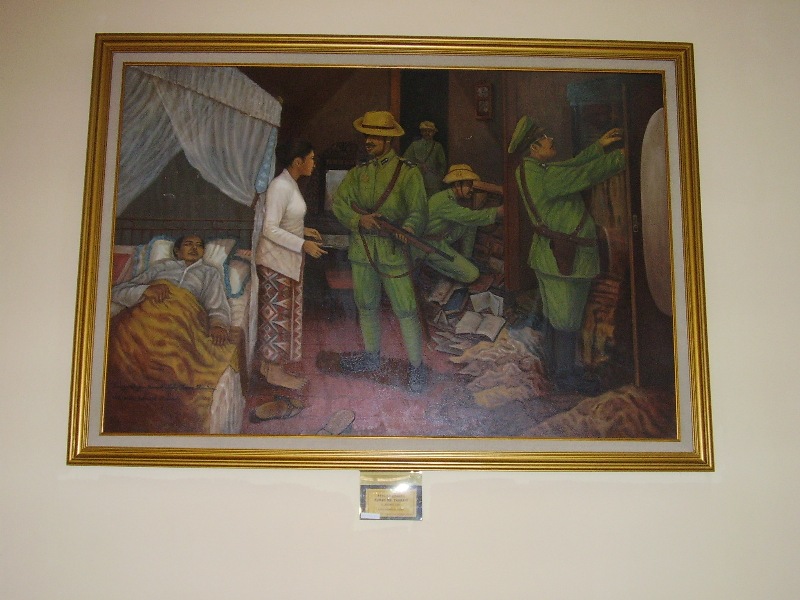
May 1941, coming home from school I learned my Dad was taken in custody by the police together with his close comrades Mohamed Husni Thamrin and Raden Mas Soetardjo Karto Hadi Koesoemo, because of their alleged contacts with the Nipponese embassy. The following days the Indonesian students at school did not dare to be close to me. The children of Soetardjo and Deetje Thamrin must have experienced the same. Thamrin, Soetardjo and my father were kept at the same police station and had to sleep on the floor for three days before they were set free. There was no proof of any espionage . My Dutch classmates, did not shy away from me. They said , “As long as there is no proof we do not believe your father is a spy!” Thamrin contracted tropical malaria during the nights at the police station and afterwards he died by this disease. Thamrin’s death was a big loss for Indonesian nationalists.
Under the following house-arrest the sick MH Thamrin was denied medical assistance by the Dutch regime. (Picture from Thamrin Museum)
After my father was set free, one of his co-workers Albert Waworoentoe told us that he knew who had made my father suspected of spying. He mentioned the name of another Minahassian who worked with my father for an organization. My father forbade us too mention this name to anybody because ,“this man has children and they will have to carry the burden later on”. Those words must have impressed all of us. 73 yrs afterwards I heard a cousin using, in a similar situation, exactly the same words.
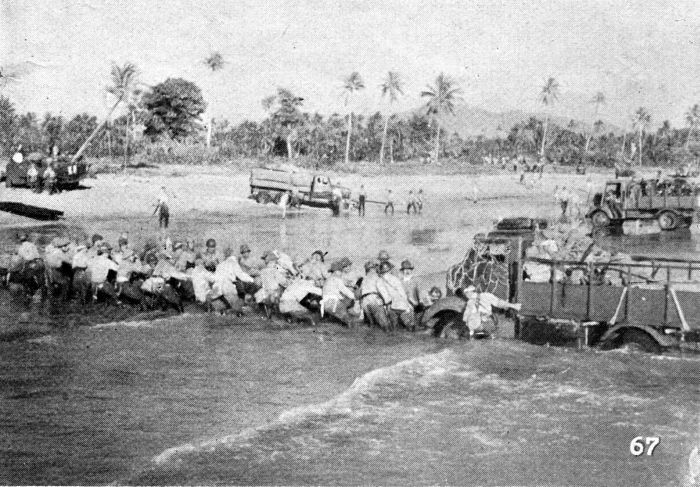
Japanese army landing on Java in 1942 (picture from Wikipedia).
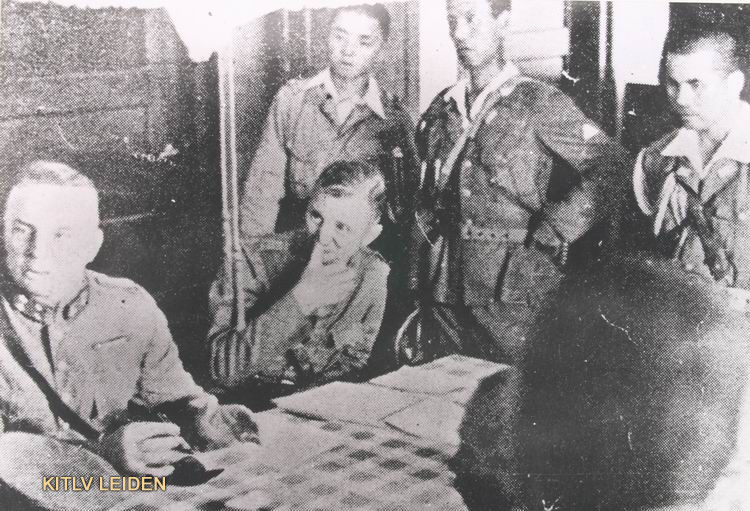
When the Japanese were going to disembark on Java, Soetardjo and my father arranged bungalows for their own families at Tjimelati, a hamlet on the slopes of the Salak mountain. My father and Soetardjo stayed at Batavia. Meanwhile Governor General Starkenborch Stachouwer was struggling to accomplish his duty. Guarding the interests of the Kingdom of the Netherlands, trying to reconcile the directions of the Government at London, with the possibilities in the Netherland Indies. He had moved the seat of the government to Bandung. The Allied Forces of Montgomery had their seat at Grand Hotel Lembang near Bandung. After the battle of the Java Seawas lost by Admiral Karel Doorman, the coast of Java was open for Nippon. Van Starkenborch decided to assign the total command of the KNIL army to General ter Poorten. When at last he faced the Nipponese army at Kalijati he felt not entitled to capitulate the Sovereign Government of the Netherland Indies. The Royal army of the Netherland Indies ( KNIL) capitulated in person by General ter Poorten.
Gen. Ter Poorten surrenders to the Japanese Army in Kalidjati (1942) , picture from Wikipedia
Nippon had still a young emperor Tenno Heikawho was involved in the expansion of the Nipponese the future prosperity and order sphere for East Asia. Nippon chose between attacking Siberia (Russia) or south Asia. The Netherland Indies and Malaka were important for Nippon because of the commodities, oil, bitumen, aluminium and rubber. They chose expansion to the South.
Spying in the Netherland Indies must have started for years before. In fact Nippon immigrants worked already in the Netherland Indies, when I was in the first classes of the Elementary school . In Purwakarta was a Japanese photographer, whose children went to school with us. Later on one of the sons of the photographer was medical student at Batavia, some years senior to me! In Manado there was a Nippon dentist that filled one of my molars with gold. Afterwards they all proofed to have been spies.
Their expansion to South East Asia, they needed the commodities of South East Asia, could get endangered by US interference. However the war in Europa and the involvement of the US was giving them their chance. Admiral Yamamoto planned the attack on Pearl Harbor, even before declaring war to the US. Pearl Harbor was the harbor where nearly the whole US naval power centered.
After the Japanese landed on Java , the Indonesian politically actives groped to find their way. Very soon it was clear Nippon did not want to have any Dutchman in a governmental organization. Very respectfully the Japanese removed all the pictures of the Netherlands Queen at the offices and put the pictures of their Tenno in her place. General Imamura directly took measures to take over the government. Already shortly after disembarking on March 1, he issued his orders relating to the Government of the East Indies.
March 8th the head of the department of the military government, colonel Josjito Nakayama asked 3 prominent nationalists to meet him, Abikoesno Tjokrosoejoso president of the Partai Sarekat Islam Indonesia, Dr. G.S.S.J. Ratulangi editor of the periodical Nationale Commentaren and former member of the Volksraad, representative of the Minahassa and Ir. Soerachman member of the Parindra and also relation of Imamura’s adviser Mr. Soejono. Nakajama’s question was , whether there were suggestions concerning governmental changes. Abikoesno thought Japan wanted the nationalists to think about some governmental organization. The best way was to form a provisional cabinet.
The next day Abikoesno called a meeting of the board members of the PSII, the Gerindo, the Pasoendan, the Persatuan Minahassa, the Partai Arab Indonesia, de student organization Perhimpunan Pelajar Pelajar Indonesia en de Parpindo founder Mr. Moh. Yamin , member of the Volksraad. They proposed the following cabinet: Foreign affairs Mr. Soejono, Interior affairs Mr. Mon. Yamin, Economic affairs drs Moh Hatta, Defense Mayor Santoso of the ex KNIL, Finance Dr. Ratulangi, Education Ki Hadjar Dewantoro, Islamic affairs Kiai Haji Mansoer Religious teacher of the Moehammad yah schools. Transportation Abikoesno Tjokrosyoso, Pers and Propaganda Ir Soekarno (who was on his way from Padang to Java). The Indonesian press was not happy with the proposed arrangement. Some thought Abikoesno placed himself above Ir. Soekarno. Why not wait till Soekarno was at Jakarta?
March 14 the information service of the Japanese army announced Imamura’s headquarter not considered nominating Indonesians to high governmental functions. The ordinance said, for the time being all the activities, consultations, petitions and announcements a.s.o., concerning the legislation or construction of a state were forbidden. Social activities and those concerning sport, arts and sciences or philanthropic ones were allowed. The army sent to Java was a fresh from Japan. People said the army that so terribly misbehaved in Nanking was coming down thru Korea and China and probably accustomed to a different warfare.
We were informed in the mosques was spread a pamphlet: “Kill the Indo Europeans, the Menadonese and the Ambonese”. My father contacted Abikoesno Tjokroaminoto and the pamphlet disappeared. Not long afterwards the lawn in front of our house was filled up with Minahassian women and children. They were sent away from their homes , the barracks of the KNIL (Royal Netherlands Indies Army) The Nippon Army needed those barracks. The women first went to the Minahassian representative to the Volkraad, Nico Mogot, who lived around the corner. He could not help them. My father went to the deputy lord mayor of Jakarta Dahlan Abdulah, an Acehnese ex member of the Volksraad and a close friend of my father. Because the schools were closed , Dahlan gave the Minahassian women permission to use those buildings tentatively. The municipality of Jakarta also furnished the women with rice and oil. My father advised Mr. Johannes Latuharary , the representative of Ambon in the Volksraad to help the Ambonese women. All the Minahassian students were mobilized to assist the women as much as they could. Not long afterwards my father was alarmed to go at once to the old STOVIA (Stichting ter opleiding van indiesche artsen) building.
On arriving there he was confronted by a young Nippon officer. He asked the officer in English some respite for those women so they could pack. The officer did not understand English. He seemed only vexed by the old man preventing him to fulfill his commission. He kicked my father, who fell to the ground. The adolescent sons of the women cried : “Get your fathers guns (tucked who away at the bottom of the trunks) and shoot them!!!” My father hearing those shouts, roared , “Do not mix in with my affairs! I forbid you to get the guns!” He grappled to his feet and promised the women he would soon find another solution.
Afterwards we were visited by Japanese army officers. Among them was the young officer who kicked my father at the STOVIA building. The officers offered their apologies and asked my father what sort of punishment the young officer would have to get. In case my father wanted to have him executed or beheaded it would happen. My father must have been terrified by the thought of it. After some contemplation and looking at the young officer, a kind of fatherly feeling for the young warrior must have invaded him. He said to the young officer: “ I want you to remember what you did and imagine your father experiences it , when he is assisting evacuated women”. After hearing the Nippon translation, the young officer fell to his knees and bade for forgiveness.
During the occupation of the Japanese my father and Mr. Alex Maramis founded an organization called PeKaSe, Penolong Kaum Selebes, to help the women of the ex KNIL soldiers. All over Java this example was followed by leading Minahassians. At Jakarta the Pekase could use two estates , during the 17th century granted to VOC merchants, Tandjung Oost and Tandjung West. Those 2 encampments were led by Albert Ratulangi. He organized industrial activities like rope twisting or cigarette rolling to provide for living conditions. Those encampments had also their own schools and medical service. The overall management of the PeKA Se was by my father’s second wifeMarie, C.J. Ratulangi –Tambajong. Mr. Alex Maramis told the ex KNIL soldiers, their Oath to Queen Wilhelmina of the Netherlands evaporated because the Queen of the Netherlands fled het country from the German army and stayed in London. Some of the ex militaries in stayed with their women in those encampments, after they fled from the army.
The Japanese occupation of the Indies consisted of two different entities, The Rikugun or the army and the Kaigun, or the navy. In Tokio those two entities met in a Contact Counsel. To coordinate their activities. They aimed at a collective prosperity sphere in East Asia . In January 1942 the Kaigun already disembarked at the Minahassa, Tarakan (oil), Balikpapan (oil), Kendari (South Celebes), Pontianak (West Borneo) and Ambon.
In Februari 1942 they disembarked at Makassar (South Celebes), Bandjermasin South Borneo, Bali, West Timor and East Timor. They bombarded Darwin (North Australia. In Februari 1942 at Singapora General Parcival capitulated after being slain by the Rikugun. Palembang ( South East Sumatra) was captured by air assault. At the end of February 1942 during the Battle on the Java sea , the Combined Forces American ,British and Netherlands were beaten. Shortly before the capitulation of the Netherlands army at Kalijati, the Governor General Starkenborch did sent his lieutenant governor general van Mook to Australia to represent the Government of the Netherland Indie safterwards. Van Starkenborch Stachouwer was convinced once the US was involved the aggressors would lose. It seems that the Kaigun, before the capitulation of the KNIL, did not want to make prisoners of war, the defeated were all killed according to the informants.
Shortly after the capitulation of the KNIL we were visited by Dr. Andu and Zus Kandouw both respected citizens of the city Manado. They had been interned in Tjilatjap (South West of Java) by the Netherland Indies Government in relation with Pro Nippon attitudes. They warned my father because they told him, “When you are not pro Nippon, you are against Nippon”. It sounded as a warning….. Conforming General Imamura’s ordinance the propaganda department of the Nippon army started the AAA or Tiga A or Dai Tooa ( Great East Asia) movement. Social work, sport , scientific and art activities were promoted. Hitoshy Shimizu was in Jakarta to realize this command.
One ex member of the Volksraad Raden Mr. Sjamsoedin , loco lord mayor of Buitenzorg, became inspired by these possibilities. Later on Soekardjo Wirjapranoto, ex member of the Volksraad, erected a youth movement the Soerya Wirawan. Shimizu was a realist; when people came to him to offer their activity, I heard him asking whether they had an idea. When they had not he advised them to join the fight against illiteracy. I too was captured by the possibility to organize the Indonesian young women to greater independence afterwards from their future husbands. Soekenda, a member of the former forbidden youth movement Indonessia Muda and Maria Amin , a Minangkabouw girl and I were preparing this activity.
To prevent criticism afterwards, we first consulted several people such as Adam Malik leader of the former Indonesia Muda, a youth leader of the PSII, Moh. Hatta and of course Ir. Soekarno to get their consent. Ir. Soekarno told me, the first time he met the word ‘Indonesia” was on a board at the front of my father’s house at Merdika Liu in Bandung. On the Board stood “Insurance Office Indonesia”, 1922.. Enthusiasted the student Soekarno adopted the word Indonesia . Moh Hatta later on became a lecturer in our young women’s organization.
In October 1942 the Tiga A movement was dissolved because it did not really take roots. General Imamura was disappointed.. In the first week of June 1942 my father and some friends who were daily following all the activities of the Kaigun in the Pacific Ocean became alerted. The Japanese fleet was slain by the US in Midway. It could mean some change in the Nippon policy toward Indonesia, hey understood. But it did not happen at once. Possibly the Kaigun did not immediately admit their loss to the Contact counsel in Tokio .
At home we were on the alert. Then Bart Ratulangi , Freddy Maengkom and other Minahassian young men were arrested by the KenPeTai , the military police. Afterwards Freddy told me they were looking for suspicious activities of my father. The young men were tortured , at last Fredy could not stand the torture and confessed the presence of my father at a certain meeting. Freddy knew however, my father could, not possibly, have been there. Bart Ratulangi told us later on, he was tortured and at last hung in the air, his feet fastened with a rope to a beam. . But at the end he was offered excuses and admiration. Afterwards he ate together nasi goreng with his torturers.
For their Collective Sphere of Prosperity in Éast Asia General Tojo had in mind an orchestra in which Nippon was the conductor. But all the members of the orchestra had to be activated. Nippon hoped to activate China by giving it its own government under Wang Ching Wei, originally a combatant of Chiang Kai Check. But the Chinese under Wang had to give a great part of their rice crops to the Nippon army and most of their businesses were already captured by Japanese family businesses. In the north of China the communists were already active. The Japanese wanted, by their change of policy towards China , to cut down their own army there. They were now at war with the US. Many of the ex KNIL Menadonese, Ambonese, Timorese but also Javanese and Soendanese conscripted in the Heiho, an auxiliary army for Nippon. They did it to earn a living.
Although Soekarno did not really believe Dai Nippon would defeat the US, he understood the Indonesians expected his leadership towards freedom. The Japanese wanted a person with enough charisma to wake up the people for their Dai Tooa. Soekarno was a Javanese and Muslim, he would most possibly be capable to arise the people. Moreover he had been exiled by the Netherlands Government because of his appeal to the masses.
About July 1942 he agreed with Moh. Hatta. Although the one was not really a friend of the other, they decided to work together. Their aim was to work together with Dai Nippon , so the Japanese would allow more Indonesians in high functions and to erect an Indonesian army. After Soekarno did agree to collaborate with Dai Nippon to realize Dai Tooa, he made a trip through Java and was with received with enthusiasm by the masses.
Moh. Hatta and Soekarno were cooperating, like most Indonesians for the “Sphere of Greater Prosperity in East Asia”. A Tata Negara ( governmental) commission was formed with Prof. Soepomo, Ki Hajar Dewantoro, Hadji Mansoer of the Mohamadijah and Situ Gunung Mulia ( Batak Christian). Another commission, the Komissie Bahasa Indonesia for the Indonesian language, was to define the Indonesian Malay. Soekardjo Wirjopranoto proposed the idea of a pure Indonesian native movement . Among several native needs the aim was , of course , to defend the Great East Asian Co-prosperity sphere. The leadership of this movement were called the Empat Serangkai (The Four United like a shamrock) consisting of Ir. Soekarnno, drs. Moh.Hatta. Ki Hadjar Dewantoro of the Taman Siswa Schools and Kyai Hadji Mansur an Islamic teacher. Concerning the name and the purpose of the new people’s organization the four leaders had to reach the consent of the Army’s planning board, Nakajama ( born in Indonesia) and the Navy’s Miyosji ( Co worker of Rear of admiral Maeda). Many proposals were not allowed, but the name of the capital Batavia changed officially to Jakarta.
The red and white flag , the anthem Indonesia Raya and the word Indonesia, were all forbidden. Agreed upon was the name “POETERA” ( SON) an abbreviation of “ Poesat Tenaga Rakyat unruk membantoe tenaga perang” (Cente of people’s power to assist in the war efforts). Soekarno told the press on December 8th 1942, the new people’s organization would start at the 1st of 1943. But both the Rikogun and the Kaigun had still their doubts about this Indonesian proposal. It lasted untill the 1st March Soekarno could announce that on 9 March 1943 , the memorial day of the capitulation of the KNIL, that the POETERA would be inaugurated at the Ikada (Koningsplein) square. On that day the square was over flown by people and in his speech Soekarno used very often the word Indonesia……..
During the ensuing months it was striking that even the old academic Minahassians , who barely spoke Malay and identified themselves with the Dutch, at the end of meetings solidary shouted “Amerika kita strika, Inggeris kita linggis”, America we strike, Brittain we split open. . Complete with their fists threateningly in the air!
In November 1942 the Australian’s had joined the Americans in a savage struggle at Guadal Canal and lost 3.095 men while 5.451 were wounded. At last the Japanese were defeated at Guadal Canal and Papua. After these developments the Strategy of Nippon was changed, in Tokio there was decided to stop the Japanese thrust eastward in the Pacific. The westward movement of the Allied Forces had to be halted. On 1 March 1943 a convoy of Japan with 6.900 soldiers slipped out of Rabaul’s harbor to Huon Peninsula, the north east tip of New Guinea. During the following days it was repeatedly assaulted by the Allied airplanes, at last, only 950 men reached the Huon Peninsula.
That time my father succeeded to get permission to send many Minahassians students home to their families in the Minahassa by boat. He was contemplating the possibility to spread the thought of future independency of the whole archipelago after the war.
He was negotiating with the Kaigun , the possibility to be sent to Makassar to awake the people there to join an organization like the POETRA but named the SUDARA (Brother) actually acronym of Sumber Darah Rakyat . Mr. Tadjoeddin Noor, an ex member of the Volksraad from Borneo would go Borneo. My father would try to reach the people of Celebes and if possibly the other eastern islands. We were often visited by count Hideko Kodama and Nishijima. My father had often meetings with Sato the head of the Kai Gun Bukanfu, the library of the Marine. My second mother Marie Tambayong was often very afraid he would say the wrong things , because Sato liked to drink sake with my father, they were like buddies.
At about this time my father called me in his office and did show me the “Protocols of the sons of Zion”,(Editor: probably is meant “Protocols of the elders of Zion“) written by a Russian clergyman before the Russian revolution. He told me to read them, but never to tell anybody I read them, because it would harm my future. My father was somehow compelled to write about the Protocols in the news paper Asia Raya. We understood we had to be on the alert. He was warning me too.
During their occupation the Japanese paid very much attention to three parts of the population, the nationalist, the Islamists and the indigenous rulers. We were Christians. The Empat Serangkai fulfilled their promise to help popularize the idea of the Greater East Asian Co-prosperity Sphere. Soekarno promoted the popular participation to work as ‘romusha’ (laborer) for the Japanese army. Later on the Empat Serangkai complained because the Nanking government got “independence” in Januariy 1943, Birma would get it in August and the Philipines in October. When would we follow?
In May 1943 the Contact Counsel in Tokio decided Singapora and the East Indies would be incorporated in the Japanese Empire. On the isle of Java , the indigenous population would be given some self government.
April 14, 1943 the US secret service intercepted a message. The admiral Isoroko Yamamoto Commander in Chief of the Nippon Navy would be in a plane above Bougainville on April 18. On April 18, 1943 an allied plane spotted Yamamoto’s plane and shot of a wing of the plane. Consequently it plunged in the sea. This was a loss to the Kai Gun who could not conceal it and at last it had to avow its many losses in the South Pacific. Not long afterwards my father, Tadjoeddin Noor and their families got permission leave for Celebes and Borneo. I stayed at Jakarta , because the Ikadai Gakko (medical high school) started and I wanted to continue my study.
In April 1943 the POETERA members complained. Soekarno found out the Japanese sent the romusha to work in other countries, in Birma and Thailand. Furthermore railway material from Java was sent to Birma. Moh. Hatta complained there was no unity in the Nippon government since Java was under the 16th Army , Sumatra under the 25th and Borneo, Celebes and the other islands under the Navy. T he nationalists wanted more participation in the government not only in Java, but in the whole of Indonesia. They wanted their anthem the Indonesia Raya and have their own red and white flag They wanted to send their complaint m to the prime minister Tojo. But it was clear that general Harada, the successor of General Imamura , would not pass this critical letter to the prime minister. Rear Admiral Maeda was consulted by Empat Serangkai , he knew a better way. The message could travel via a naval officer who was connected to the military government of the Kaigun and be passed to Prime Minister Tojo. On Juli 5th general Harada announced the installation of several indigenous advisory councils for cities and municipalities.
Juli 7th the Empat Serangkai, the advisory council for the Tata Negara , the Masyumi (big Islamic organization) , the four autonomous rulers and the indigenous government officials had all to be present at Prime Minister Tojo’s arrival . Soekarno expressed his appraisal of the visit by the Nippon Prime Minister as an older brother During the centuries of Netherlands domination such had never happened. He promised more assistance for the Japanese war effort. Prime minister Tojo, however pleased he might have been , could not promise more than the Tokio Contact Counsel allowed him. No more participation in Government of Java.
The 7th June 1944 General Harada announced the POETERA would be phased out. A new organization the JAVA HOKOKAI or Himpunen Kebaktian Rakyat ( loyal popular organization ) would take its place. It had about the same targets as the POETERA, but every body could join , from the age of 14 yrs onwards, after being approved by the local indigenous government, Chinese, Arab and Indoeuropeans could join. The whole population of Java had to be organized in small tonairi gumis (communities) led by a gumicho, assisted by 8 hanchos for the distribution of tasks to clean the quarter, concerning the agriculture, hygiene etc. By the tonari gumi the Japanese army had total control over the population of Java.
On 7 September 1944 Soekarno was called to the Palace of General Harada and was informed that Prime Minister Koisho, Tojo’ the successor announced that Indonesia would be independent at the end of 1945. The red and white flag was allowed. Soekarno was surprised ! The Barisan Pelopor was formed. Every man of 25 yrs could be a member. Each town had some unities of 20 members, each district had several battalions, Ir. Soekarno would be the commander. The Barisan Pelopor was not really armed, they did only carry bamboo runtjing (shatpened bamboo sticks). One week of festivity followed. Also the Pembela Tanah Air (PETA) , voluntary army for the defence of the home land under Japanese leadership was founded. In March 1945 a Civil Governmental Academy was founded, one for 50 accomplished higher civil servants and another for 150 persons who had already an academic or followed some further education..
February 1945 the PETA revolted. January General Harada had proposed a commission to investigate the possibility of independence. This was followed by much criticism from other Japanese occupational forces On May 5, Shimizu planned a big meeting of the students of the middle schools of Java at the Villa Isola, Bandung. The medical students , asked my opinion, because we were not invited. I suggested we all could go to the Villa Isola and propose to the middle school students to claim the participation of the medical students. So we did and after we were also invited too, my colleagues asked me what would be our next position. I proposed the claiming of Independence at once., Kemerdekaan segera. In the end we succeeded again. After this meeting , all over Java the students of thee middle schools organized demonstrations claiming: ‘Kemerdekaan Sekarang juga!’
On the 29th of May 1945 was the first meeting of the Badan Penyelidik Usaha Persiapan Kemerdekaan Indonesia (BPUPKI) in the old Volksraad building. The body investigating the possibility of independence. The chairman was Dr. K.Radjiman .T.Wedyodiningrat (born 21-04-1879). During the next 3 days there were deliberations after introductory talks of Moh. Yamin, a Minangkabouw ex Volksraad representative and Prof. Soepomo from the Juridical Faculty.
On the 1st of June Ir. Soekarno brought his compilation of the deliberations during those 3 days. He noted 5 principles :
First . Nationalism based on the collective wish to be together. , Second . Humanism, the philosophy asserting the dignity and worth of mankind. Third. Democracy based on consent of a plurality. Fourth. Kesejahteraan social. Common wellbeing of the people Fifth. Ketuhanan, the belief in God.
The PANCA SILA was born !!! The pillars supporting the Indonesian State. We all had the feeling God was with us. The next meetings of the BPUPKI took place in June and and July 1945. There were formed several sub commissions. The most important little commission was on planning of the Constitution. Consisting of Prof. Soepomo, Mr. Toemenggoeng Wongsonegoro, Mr. Soebardjo, Mr. Pandji Singgih, Mr. Max Maramis, Haji Agoes Salim dan Dr. Soekiman Wiryosandjoyo. When this little council met on 13-07-1945, the medical students were alerted.
They tried to be in the council room in the Volksraad. We, the female students were asked to prepare the food for the council members at the hotel Savoy. When we were ready we went to the Volksraad building to find the male students sitting and lying on the lawn surrounding the building. Before the entrance were positioned Japanese soldiers fully armed. Before realizing the danger, I put down my bike and went up to the entrance gesturing to the soldiers to put down their weapons and the students to follow me, what they did. On entering the public side of the council room it was clear the council members got aware of our presence.
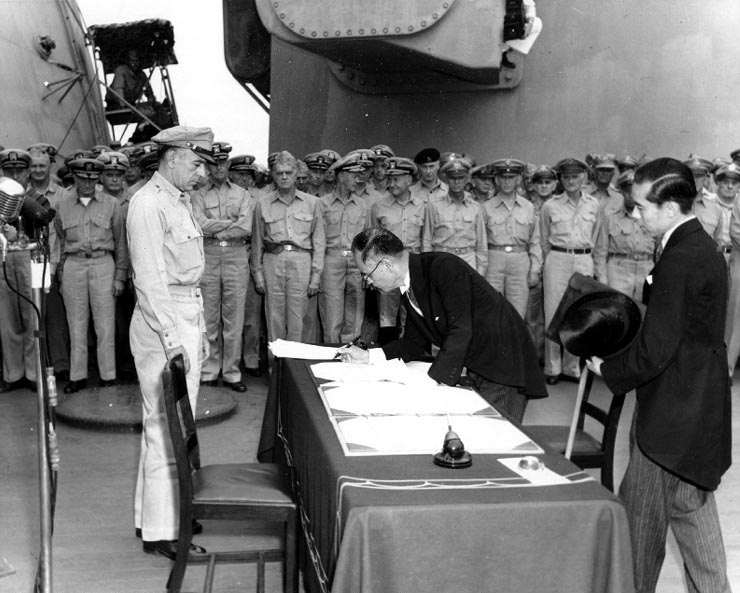
We knew of a compromise Ir. Soekarno tried to reach, called the Piagam Jakarta or the Jakarta Charter. The compromise was between the Muslims and the Nationalists . It concerned article 29 of the proposed constitution concerning the Religion. The Believe in God, “ while the adherents to the Islam had to live according to the Shari’a”. Haji Abdoel Wachid Hasyim , President of the Madjelis Islam A’laa Indonesia, was a Cairo educated Member of the Muslim Brotherhood . He had claimed Indonesia to be an Islam state, based on the fact that 95% of the Indonesian population was Islam. One can understand Ir. Soekarno cherished the ultimately reached compromise . The compromise was called the Piagam Jakarta or the Jakarta Charter dated 22 Juli 1945. 15 August the Emperor Hiro Hito capitulated after Hiroshima and Nagasaki were hit by atom bombs.
I was approached by the president of the Christian student organization, Oscar E. Engelen. The Christian students were not happy with the compromise because the commitment to be living according to the shari’a by Muslims would split the Indonesian people. I knew most of the medical students were also against the Piagam.. So as last resort we planned to put the problem to my father. He came to Jakarta ( Editor: from Makassar where he was staying at that time) together with other representatives from the islands outside of Java on August 15. When my father was settled in hotel des Indes we told him it was difficult for us to join the coming independence struggle when the Piagam Jakarta was included in the Constitution.
My father promised to think about it.
The next day he told me , he took our problem to Mr. Haji Teuku Moehamad Hasan from Aceh. He was a well known scholar of Islamic law. Teuku Moeh. Hasan told my father he could live in a country as long as the laws of that country were not against the Islam. My father asked him to let this opinion be known to constitution commission, mainly to Soekarno and Hatta. My father could not do it, being a Christian.
At that time the medical student hostel proofed to be closed for the female students. The male students were all included in a kidnapping of Soekarno- Hatta. This action seemed to be led by the older , pre war student leaders of the PPPI, Soekarni, Chairul Saleh, Wikana and others. They kidnapped Soekarno-Hatta who did not want to declare the independence immediately. Both were brought to a little town near Jakarta, Rengasdengklok. Soekarno-Hatta still refused to declare the independence while the Japanese army were still in power.
Mr. Soebardjo noted both the leaders were no longer in Jakarta. He consulted Maeda. The Kenpeitai was instructed to seek it out. At last Nishijima found out where they were. Soebardjo decided to go to Rengasdengklok together with a worker of Maeda, to convey the message the Rear Admiral Maeda wanted to cooperate. His house was at the disposal for the meetings. He guaranteed their safe return to Jakarta. Before going to Rengas dengklok Soebardjo sent message to the members of the BUPKI and the representatives of the outer islands , to be present at Maeda’s house at 10 o’clock.
Soekarno-Hatta arrived there in the night of the 16th August. There upon Maeda had a long telephone call with general Nishimura in which he threatened there would be big upheavals tomorrow when there did not happen anything. Soekarno still tried to get any cooperation from the Japanese army, but the general did stick to the orders from Tokio, not to change the status quo after Nippon’s capitulation. He promised however the army would not interfere when the Indonesians declared their independence.
At the house of Maeda ,Soekarno complained that he had no guards at all, his army had only the bamboo runcing. My father promised him a well trained guard. The ex KNIL soldiers had during the occupation, found a job as chucker-outs of the Chinese gambling houses at Passar Senen. These men promised my father they would do anything he asked them. After the Proclamation on the 17th of August 1945 President Soekarno and vice president Moh. Hatta had their guards, sturdy Minahassian ex soldiers.
Vice president Hatta said in his speech at the Declaration of Independence, the president will be an authentic Indonesian. The vice president Hatta added: “The obligation of Indonesians to live in accordance with the shari’a “, can be scratched out of the preliminary constitution. “Those people of the outer islands, who are Christians, also can stand up for our constitution.”
After the Netherlands Indies Civil Administration tried to take root again , among the first things they did was , imprisoning Rear Admiral Maeda and Nishijima in the Struiswijk jail at Jakarta because they did not keep the Status Quo after the capitulation of Japan. After the war Nishijima became Professor at the Waseda University at Tokio. I visited with Prof. Nishijima Rear Admiral Maeda’s grave. He was buried at the site of the Tokio Cemetery where Prime Minister Tojo, Admiral Yamamoto and others found their last resting place, the site is called ” Yasukuni Shrine”, dedicated to the Nipponese War criminals.
Bibliography:
Het Koninlrijk der Nederlanden. 11a&b. Dr. L. de Jong, 1984.
Island Fighting . Time Life Books . Rafael Steinberg, 1998.
Risalah Sidang Badan Penyelidik Usaha Usaha Persiapan Kemerdekaan Indonesia. BPUPKI, Panitia persiapan Kemerdekaan Indonesia. PPKI, 29 Mei 1945- 19 Augutus 1945. Sekretariat Negara Republik Indonesia. 1992.
Meeting with Prof. Nishijima of the Wasada university at Tokio, 1987.
Remembrances of Emilia A. Pangalila-Ratulangi PhD. Md. Amsterdam University
I embedded a piece by Tchaikovsky to try to transmit the feeling of disappointment that my father might have felt facing difficulties in his efforts to repeat what he did successfully 10 years before which was the publishing of a weekly magazine in Jakarta (“Nationale Commentaren”).
The editors of the book IN HET LAND van de OVERHEERSER have titled the period 1913 – 1920 as “Emancipatie in samenwerking” or in English : Emancipation in Cooperation. To me this description is very much heavy on the Dutch opinion, especially the term Cooperation most certainly will not be shared by the Indonesian side at that time.
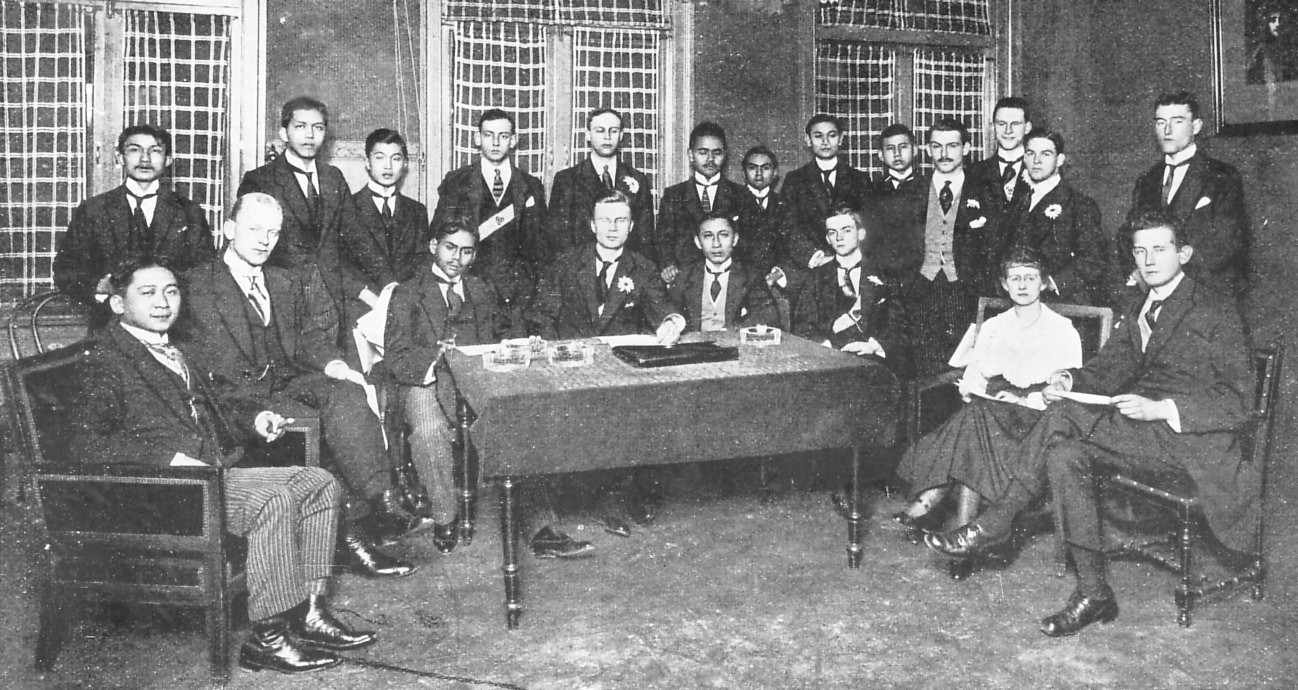
Indeed the year 1913 brought a new, fresh wind from the south to the student world in Holland. Those who had the sensitivity to observe this were individuals like Jonkman, who was active in the student organizations particularly in those that related to overseas (“colonial”) matters. Since 1916 he was suggesting the need for a Congress for Indonesians and persons who would be active in Nederlands Indie in all sort of professions. And after being discussed at meetings at the
Participating org. Board Members, seated from left no 2 : JONKMAN, no 4 v.MOOK (1917)
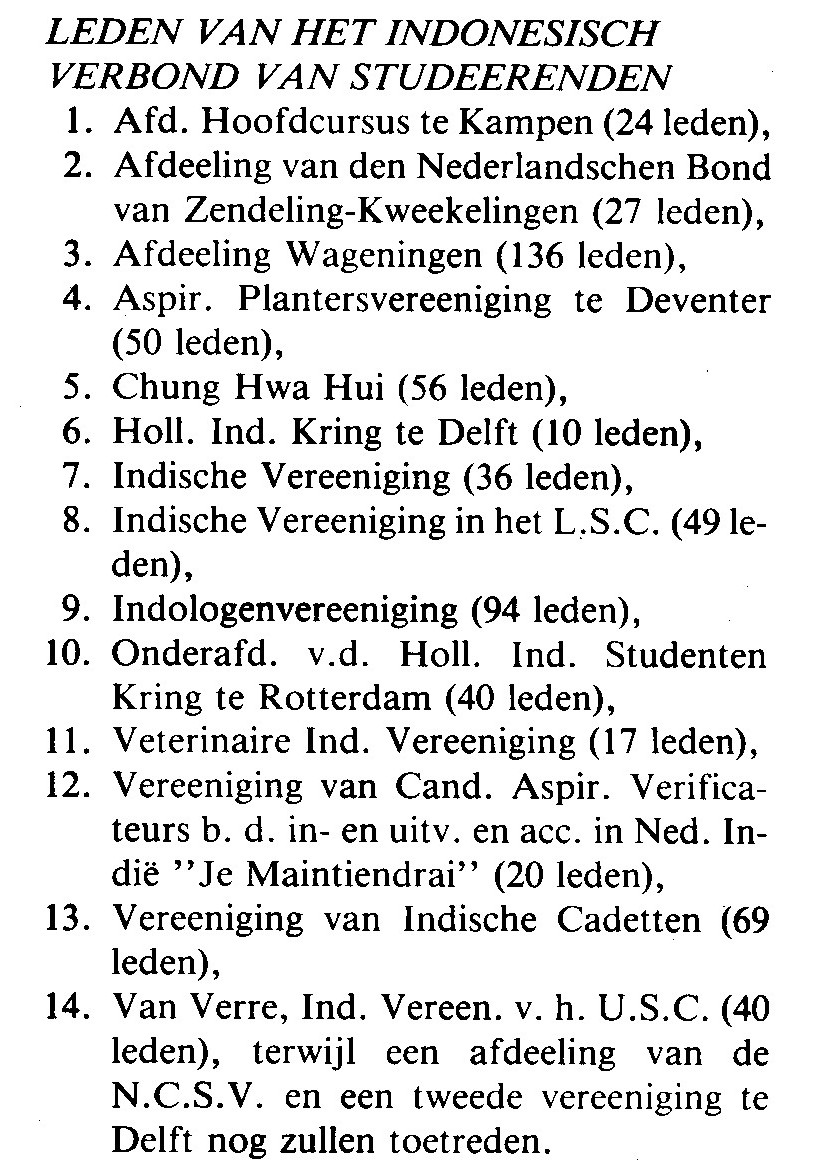
various University Student Corps’ in 1917 it was finally decided that the next year on 29 / 31 August 1918 a congress would take place with many student & professional organization such as can be read in the exhibit below. Indeed a well prepared representation of various professionsi the Ned. Indies in 1918
Participating organizations
And on D-Day actually a relatively good number of participants came up although for the organizing committee rather disappointing
All participants of the Congress (1918)
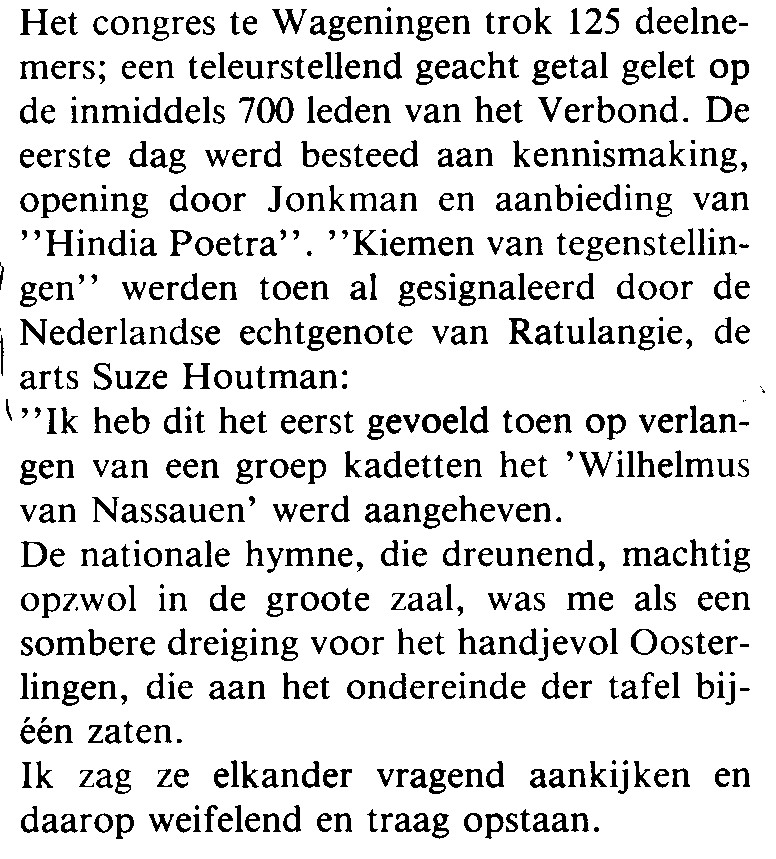
The atmosphere was warm and friendly, however for carefully observing individuals a slight discomfort due to early signs of a contradiction was felt as is described in the following exhibit.
alkFrom “Hindia Poetra”
Observation by Suze Houtman (at that time the spouse of Sam Ratulangie) she was working at her doctorate in medicine at the UVA. She described that she observed seeds of contradiction in the reluctance of the Indonesian participants of the Congress to join in singing “Wilhelmus van Nassauen” which is the Dutch National Anthem. The Indonesians looked at each other with a questioning expression but in order to maintain good manners and to be polite, did stand up slowly.
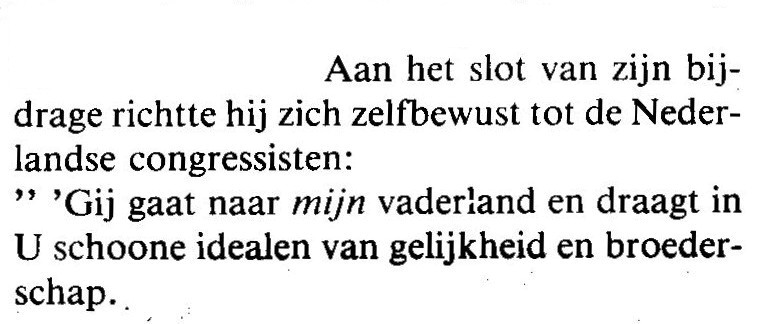
At this Congress SAM RATULANGIE also gave a presentation about the Association d’Etudiantes Asiatique in Zuerich, which he chaired. Also on his idea of “Het Nieuw Aziatisme” (The New Asiatism), whilst he ended his talk dedicated to the attendants of the Congress as in the following exhibit:
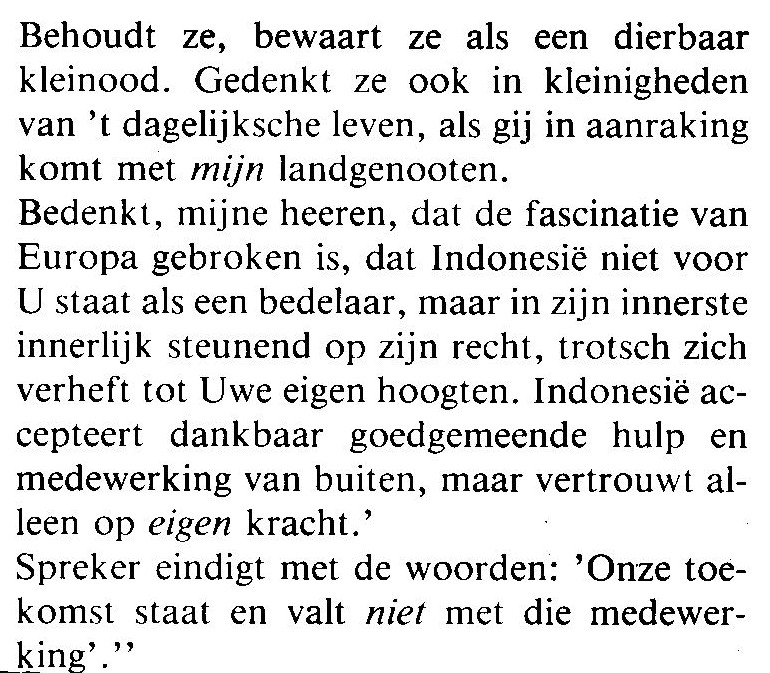
Sam Ratulangie’s words (1918)
Sam Ratulangie was addressing those who will come to his country later, and asked them to keep the memories of equality and brotherhood obtained at this congress, “keep it as a souvenir and remember it in your daily life when you are in contact with my people. Remember, gentlemen, that the fascination of Europe is broken and that Indonesia stands in front of you not as a beggar but in his deepest inside relying on his right, rises himself with pride equal to your height. Indonesia will gratefully accept sincere help and cooperation from the outside, but relies only on its own capability. Our future does not depend on this cooperation.”
Enormously brave words for 1918.
Notes from the Editor: Pictures and Exhibits above are scanned from the book : “IN HET LAND van de OVERHEERSER’, Pending Permission, Thank you
At the moment. in July 2013, nearly a hundred years later, let us join Kishore Mahbubani who argues that we are on the doorsteps of observing another CHANGEin ASIA :
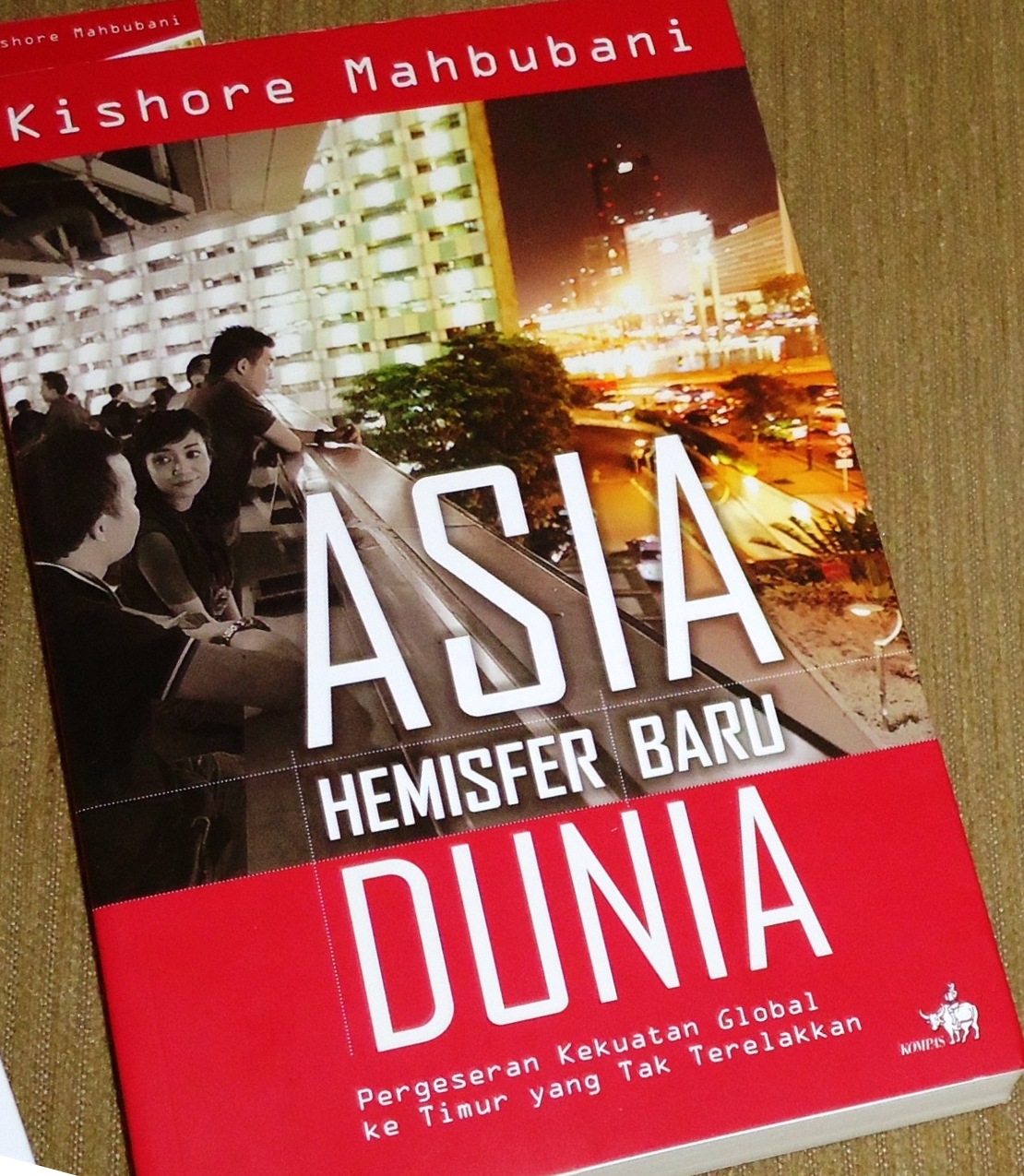
Kishore Mahbubani is the author of the book titled “THE NEW ASIAN HEMISPHERE, The irresistable shift of power to the East ” (2011) translated in many languages, among others in the Indonesian Language (below)
ASIA hemisfir baru DUNIA
….and listening to Prof. NOAM CHOMSKY (MIT) with his speech titled
“WHO OWNS THE WORLD?’
is indeed VERY interesting……
NEXT
SAM RATULANGIE and the ASIAN STUDENT ASSOCIATION in Switzerland (1918)
“Max Havelaar”, Indische Vereeniging & “ETHISCHE POLITIEK”
Colonialsm
To many people, both Dutch as well as Indonesian, the book titled “Max Havelaar” is not an unknown. Many people have read it but many more only know about it. The book (a picture of the cover is shown below) was written by Eduard Douwes Dekker under the pseudonym Multatuli (meaning “many sufferings”) published in 1860. A movie with the same title was produced in 1976 (by the Dutch) of which a (YouTube) clip is shown below.
Cover of “MAX HAVELAAR”
From Wikipedia English: “Multatuli wrote Max Havelaar in protest against these colonial policies, but another goal was to seek rehabilitation for his resignation from governmental service. Despite its terse writing style, it raised the awareness of Europeans living in Europe at the time that the wealth that they enjoyed was the result of suffering in other parts of the world. This awareness eventually formed the motivation for the new Ethical Policy by which the Dutch colonial government attempted to “repay” their debt to their colonial subjects by providing education to some classes of natives, generally members of the elite loyal to the colonial government.
(The) Indonesian novelist Pramoedya Ananta Toer argued that by triggering these educational reforms, Max Havelaar was in turn responsible for the nationalist movement that ended Dutch colonialism in Indonesia after 1945, and which was instrumental in the call for decolonization in Africa and elsewhere in the world. Thus, according to Pramoedya, Max Havelaar is “the book that killed colonialism“.[1]
In the last chapter the author announces that he will translate the book “into the few languages I know, and into the many languages I can learn.” In fact, Max Havelaarhas been translated into thirty-four languages. It was first translated into English in 1868. In Indonesia, the novel was cited as an inspiration by Sukarno and other early nationalist leaders, such as the author’s Indo (Eurasian) descendant Ernest Douwes Dekker, who had read it in its original Dutch. It was not translated into Indonesian until 1972.[2]“
To read the book “MAX HAVELAAR” in English on your computer click here.
A few days ago I found a file that has been hidden for some months in the chaos of my computer. It was a document given by my elder sister to me. This document contained material drafted for further elaboration by a very good friend of us who intends to write a biography on Sam Ratulangie. In this document mention was made about the very early days of the Indische Vereeniging. It showed how those nostalgic Dutch people who once were in Nederlands Indie came together to chit-chat about the time and the memories they had in Indie. The group consisted not only of Dutch pensionars but later also young people from Indie who came to Holland for study.
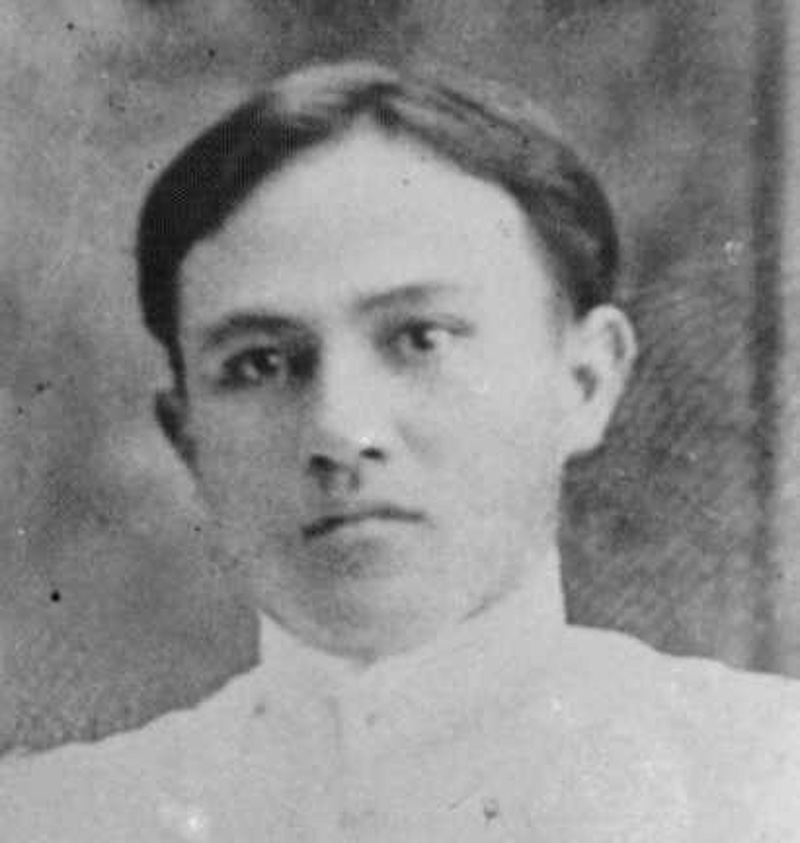
Sam Ratulangie (Age 20)
Among many others,Sam Ratulangie who arrived in 1913, had to adapt to the new circumstances and had to concentrate first on trying to obtain the means for a living and also on preparing himself to enter the University of Amsterdamto start his study to become a qualified teacher in mathematics. According to unconfirmed information he also worked some time at Amsterdam’s harbour in his first summer, however upon the end of summer he intensified his efforts in writing small contributions to various media, daily newspapers as well as weekly’s. After joining the Indische Vereeniging apparently due to his writing activities Sam very soon became popular among his coutrymen and in 1914 was elected to become the chairman for the 1914 – 1915 period of the I.V.
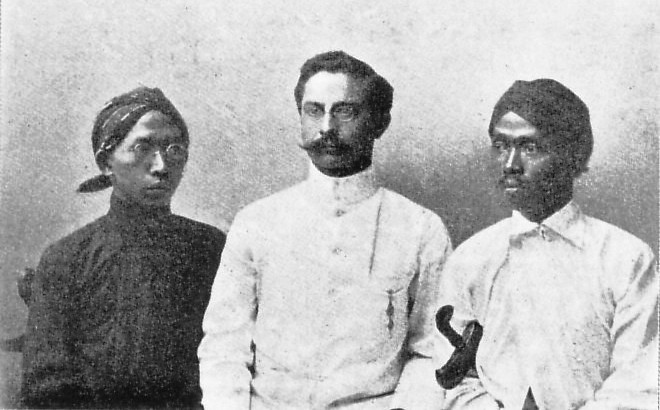
Three exiles by the colonial regime (1913) Soewardi Soerjaningrat (Ki Hajar Dewantoro), E.F.E. Douwes Dekker (Setiabudi), Tjipto Mangoenkoesoemo
Further, in the same year three personalities also arrived in Holland. They were E.F.E. Douwes Dekker (who was a nephew of Eduard Douwes Dekker and later adopted the name Setiabudi), Tjipto Mangunkusumo and Suwardi Surjaningrat alias Ki Hajar Dewantoro(Wikipedia: He is the founder of the College: Taman Siswa or .Student Park, an educational institution that provides an opportunity for indigenous commoners to earn the right to education as well as the aristocracy ) . The trio were exiled by the colonial government to Holland because of their “revolutionary” activities among others because of the criticism expressed in their writings in a publication named “Insulinde” and was found to be too provocative. In the Indies namely an atmosphere of reluctance of the colonial government to adopt the Ethische Politiekas instructed by the homeland. As mentioned above a sense of bad conscience had come up in Holland after finding out about the real inhumanity of the Dutch colonial exploitation and corruption that was applied to the people of the Indies. The trio became members of the I.V. and contributed very much to the organization.
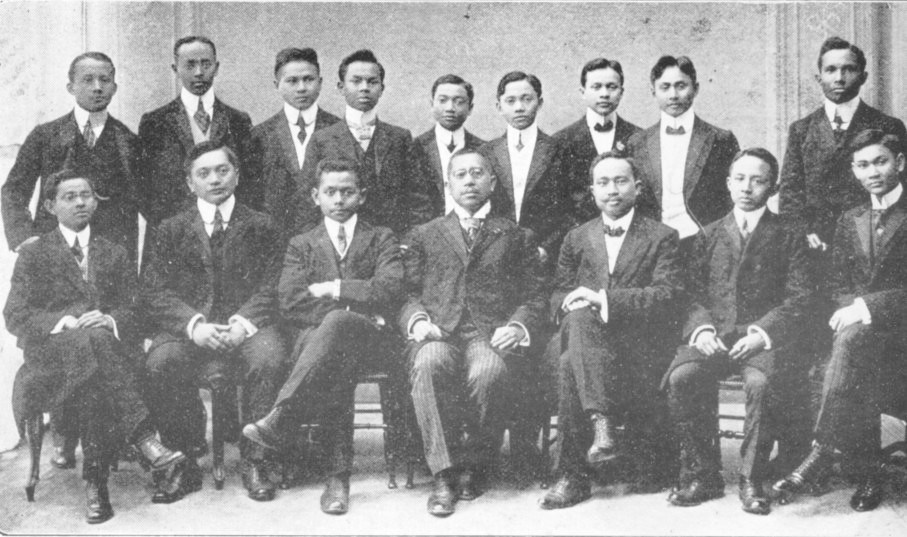
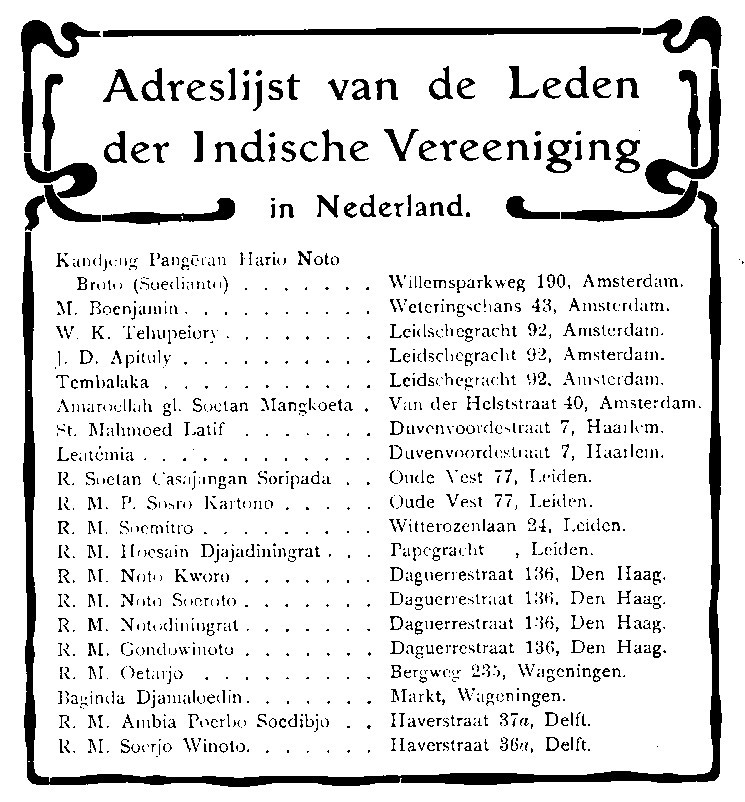
Upon advice of Mr. Abendanonwho was an advisor to the group the Indische Vereeniging was officially structured and on 25th October 1908 with the presence of 15 “Indiers” a temporary board was established with R. Soetan Casajangan Soripada as Chairman and R. Soemitro as Secretary, whilst a Committee for further development was also chosen.
Members of the Indische Vereeniging (1908)List of Indonesian Members and their Addresses (1908)
NOTE: Most of the pictures in this posting are scanned from the book: “IN HET LAND VAN DE OVERHEERSER I” (In the country of the oppressor), by H.A. Poeze et. al. KITLV 1986. ( There is an Indonesian translation 2002) :
In the oppressors country (In het land v/d overheersers)
For Sam Ratulangie the casual and uninhibited atmosphere among “oppressors” and “the oppressed”at the Indische Vereeniging was mostly reviving. Namely, years before, after finishing his technical education, when he began his career as a technician at the State Railway in a town in West Java he had to face a bitter humiliation. It was hard to accept for a young man who always proofed to be among the best at school to suddenly be treated as unworthy living at the same hostel as his ex-schoolmates because of his skin color. He was not allowed to stay at the hostel as his colleagues, but had to find himself a living quarter somewhere in the kampung. This painful experience of racial discrimination had a profound effect on Sam Ratulangie’s further life. However as with many other creative persons this traumatic happening was turned by Sam into a most enriching encounters with the local population of the desa where he found his quarter. Among others he came to meet the people who were actively engaged in the Sarekat Islam and was briefed about their motivations and their objectives. These observations were boiled down in a document that he later published at a publisher in Baarn Holland titled “Serikat Islam“.
Whilst the 1913 world was (of course) different as the 2013 one, certain similarities show up to me…… The PANTA RHEIprincipe applies and ” All things come into being by conflict of opposites, and the sum of things flows like a stream.”
I remember the words of Sam Ratulangieat the end of the Introduction of a book he intended to publish: “Indonesia dalam gelora internasional” (1949) : ” ….. but each power system contains elements for distruction and anihilation of it selves. The same is valid for each colonial system although steered with pure slogans that however are only abstract. That is the irrational process, the process of correction by justice. It is as if The Almighty intends to correct its errors using human capacity without their own awareness ….”
The original text in (old) Indonesian language:
“….. akan tetapi tiap-tiap susunan kekuasaan mengandung unsur-unsur untuk menghantjurkan dan memusnahkan diri sendiri. Demikian djuga susunan djadjahan jang dikendalikan dengan sembojan– sembojan jang murni akan tetapi jang hanja maja belaka. Hal tersebut ialah proses jang gaib, proses dari pembetulan dari keadilan. Seolah-olah dengan proses itu Pengendali Alam bermaksud membetulkan kechilafan-kechilafan dengan mempergunakan tenaga manusia, akan tetapi diluar kesadaran penglaksana insani sendiri……” (masih dengan ejaan lama karena ditulis ditahun 1949).
Dengan terjadinya ketegangan2 diintern negara2 Eropa, sedangkan diujung Timur pun antara Rusia dan Jepang yang berperang dengan menghasilkankemenangan bagi Jepang, dan di negeri Tiongkok dinasti Ching mengalami kehancuran maka jelaslah bahwa saat2 itu terjadi satu perubahan tata susun diberbagai bagian belahan dunia. Perubahan2 ini disertai timbul tenggelamnya aliran2 politik. Hal2 ini dengan ramainya didiskusikan di Indische Vereeniging, pemikiran2 baru seperti yang dijabarkan oleh Rabindranath Tagoremendapat perhatian yang cukup besar diantara anggauta I.V. Sedangkan bacaan2 seperti tulisan Rudyard Kippling, Multatuli maupun Lenin dan Marx ditelaah dan didiskusikan. (Sorry for the regression to the Indonesian language above. This is corrected below.)
At that time tensions were mounting among the nations of EUROPE, whilst way up to the north eastern side Russia and Japanwere warring, leaving Russia as the looser, whilst in the Kingdom of the Middle the Ching dynasty was destroyed. It was clear that there was (to be) a distinct change in the structure of many parts of the world. These changes brought with them (if not, they were caused by) a raise and fall of political ideologies. All about these developments were intensively discussed at the Indische Vereeniging. Also about the literary contributions of Rabindranath Tagore, Rudyard Kipling, Multatuli as well of Karl Marxand Lenin.
As a repercussion towards all these new inputs a discussion was organised by the I.V. for their members and also other interested individuals in the Hague late 1917 with the theme : “COLONIALISM; benevolance or crime?”, (“Kolonialisme, Berkat atau Kejahatan?) . On an interview much later in the 1960’s, with Mr. Jonkmanwho in 1917 as student was also present at the discussion, there was a report in which the latter mentioned smilingly: “We were all so very idealistic at the time, and imbued by the theory of the “ethical policy” and so convinced that the Dutch prescence in Indonesia was the most enlightened and benevolent kind of government possible ”
After hearing the many contributions, it was apparent that the meeting would favor the idea of colonialism to be a blessing for those poor “suckers” in the Indies. Until Sam Ratulangie stood up, filled with impatience, he said in a loud voice: “Colonialism is a CRIME! It is the greatest crime against humanity!” These words came as a thunder on broad daylight and caused turmoil and shouting all over the room…it jeopardized the whole meeting which was closed in a hurry. This affair was named THE HAGUE FURORE and was not forgotten long after that , but it was also not without penalties for Sam Ratulangie. The University of Amsterdam, after it was being informed of the happening, decided that such rebellious expressions of its students could not be tolerated by the University. It was Mr. Abendanon who took Sam Ratulangie aside and delivered the message, but understandingly, he also gave Sam the advice better to finish his doctorate (which was nearly completed by then) at a university in Switzerland. This country was able to maintain its neutrality in that stressful period in Europe and Mr. Abendanon was sure that Sam might find a welcome at one of its universities, and that was what actually happened.
EPIILOG
It might have been in the late 1970’s that my mother, who at that time lived in a small house in southern Jakarta, was being visited by a Dutch lady. That was what she told me, and I scarcely made any notion of what she said. ” Yes,” my mother continued, “it was Mevrouw Jonkman.” Now I remember that name as it was often mentioned at lunch, when I was a kid and we sat with the whole family, plus the few relatives nieces and nephew who were boarding in our house, sent by their parents to get a better education in Batavia, than they could have at home in Manado. “And?” I asked , because my mother looked at me with an expression that she was not yet finished with her story. “Mevrouw Jonkman brought a book for me as a present, because that was what her husband had told her to do before he passed away….” The book was about Mr.J. A. Jonkman, sort of Memoirs….. And her husband had asked her whenever she goes to Indonesia, she should visit Sam Ratulangie’s widow to give her a copy of this book. “….because Mr. Jonkman had always respected Sam Ratulangie, both at the time of study as well as later, although they were standing as opponents towards each other in their professional career…..”



 Note: Thank you Jeanine for sending us this beautiful picture of your Mom’s wedding.
















 Laniratulangi's Blog